Our survey is now closed.
But you can still check out the results and the vidcast.
Home | Blog | Female health | HRT | Let’s Talk Menopause: with Seema Malhotra
Super-exciting news. To get ready for World Menopause Month in October, we’re launching Let’s Talk Menopause.
The campaign will help to raise awareness of menopause, discuss the impact it has on women, and give you the platform to share your experiences.
Last updated on Aug 28, 2023.

To help us, we’ve teamed up with UK TV personality and entrepreneur Seema Malhotra, and Boston-based fashion influencer Susan Kanoff.
Over the coming weeks, we’ll be working with Susan, alongside UK TV personality and entrepreneur Seema Malhotra, to spread the word on social media, sharing videos featuring expert insight from our clinical team. From how to know menopause started, to how it can affect your skin, lifestyle fixes and HRT – anything you ever wanted to know about menopause but didn’t know who to ask, we’ll aim to answer.
But you can still check out the results and the vidcast.
It’s just 12 questions long, and at the end of it you’ll be given a chance to enter our prize draw to win $200 in Amazon vouchers.
What’s more, you don’t need to have experienced menopause personally to enter – we want to hear from adults of all age ranges, and all genders.
‘I’m thrilled to work with Treated to help spread awareness of the roller coaster ride called menopause.’ said Susan. ‘Information and resources are crucial for navigating menopausal changes in order to live fully and make educated health decisions. Knowledge is power!’
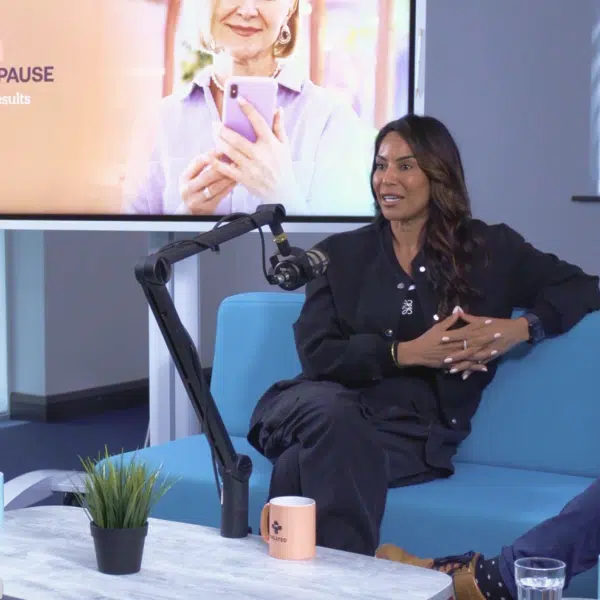
After the survey closes, we’ll discuss our findings from the survey in an exclusive vidcast, featuring some special guests.
Menopause affects every woman differently. Some women don’t get any noticeable symptoms, but it’s estimated around 75% will . And out of that 75%, not everyone will necessarily know what their symptoms mean when they start. A survey of perimenopausal women found that 68% only actively looked for information about it after noticing the onset of symptoms .
‘A general lack of awareness about menopause symptoms and the impact they can have is probably central to this.’ says Dr Daniel Atkinson.
‘A lot of women (and partners of women) don’t know much about menopause until it begins to directly affect them or someone close to them.’
While knowing about symptoms is one thing, seeking treatment is often something else entirely – and many women won’t get advice from a doctor or discuss the support that’s available to them. A recent analysis of peri- to post-menopausal women in France, Germany, Italy, Spain, and the United Kingdom, found that only just over half (54%) sought treatment or medical advice for symptoms .
‘Sometimes it’s because women going through menopause don’t know the range of support that’s available, but other times they might just feel like their symptoms don’t warrant the fuss of seeing a doctor.’ said Daniel.
‘Which is a shame, because it means a lot of women go through this period of sometimes quite intense physical hardship – which can last a few years – without speaking up about it.’
Luckily, a number of high profile women have spoken out about their menopause symptoms publically in recent years, to help spread awareness of the impact it can have. Davina McCall, Salma Hayek and even Michelle Obama have opened up about how menopause has affected them – and in 2022, the UK’s Real Housewives of Cheshire star Seema Malhotra joined this illustrious list.
Recounting her experiences on Real Housewives and in interviews, Seema highlighted the lack of education around the subject, and the obstacles many women face getting partners and family to understand what menopause is really like.
Her aim when filming the menopause special edition of Real Housewives was to help women know more about menopause and the support that’s available – and this is something she’s seeking to further by working with us.
‘I am absolutely thrilled to be a part of this menopause campaign alongside Treated.
'It is an incredible opportunity to not only raise awareness about this important stage of life, but also to share expert advice and support with women everywhere. Together, we can empower and educate, making a positive impact on the lives of so many.’
As Dr Daniel also explains, hearing about your experiences will help us to know more about attitudes to menopause, and help us to highlight knowledge gaps for discussion.
‘It’ll be really interesting to see not only how much people know about menopause, but also how they feel about it too and their perceptions of it – it’s a subject that’s still somehow taboo, despite the fact that every woman goes through it. By participating and completing the survey, you’re helping us to know more about why it’s a taboo, so we can continue working towards breaking the stigma.’
The British Menopause Society response to the Department of Health and Social Care’s call for evidence to help inform the development of the government’s Women’s Health Strategy. [online] British Menopause Society. Available at:
Biswakarma, R., Yasmin, E., Saridogan, E., Radhakrishnan, S., C Davies, M. and Talaulikar, V. (2022). An online survey of perimenopausal women to determine their attitudes and knowledge of the menopause. Women’s Health, 18, p.174550572211068.
Graham, S., Clerinx, C., Bernick, B.A., Krassan, M., Mirkin, S. and Currie, H. (2016). Behaviours and attitudes influencing treatment decisions for menopausal symptoms in five European countries. Post Reproductive Health, 22(3), pp.112–122.doi:https://doi.org/10.1177/2053369116632439.
How we source info.
When we present you with stats, data, opinion or a consensus, we’ll tell you where this came from. And we’ll only present data as clinically reliable if it’s come from a reputable source, such as a state or government-funded health body, a peer-reviewed medical journal, or a recognised analytics or data body. Read more in our editorial policy.
Have a subject you’d like us to cover in a future article? Let us know.
We're making healthcare more about you. Sign up to our newsletter for personalised health articles that make a difference.
Disclaimer: The information provided on this page is not a substitute for professional medical advice, diagnosis, or treatment. If you have any questions or concerns about your health, please talk to a doctor.
Authorised and Regulated by:

We couldn't find what you're looking for.
Here's everything we treat. Or, if you're looking for something we don't have yet, you can suggest something.
(And leave your email too, so we can let you know if we write an article based on your suggestion.)
Last updated on Aug 28, 2023.
Our experts continually monitor new findings in health and medicine, and we update our articles when new info becomes available.
Aug 28, 2023
Published by: The Treated Content Team. Medically reviewed by: Dr Daniel Atkinson, Clinical ReviewerHow we source info.
When we present you with stats, data, opinion or a consensus, we’ll tell you where this came from. And we’ll only present data as clinically reliable if it’s come from a reputable source, such as a state or government-funded health body, a peer-reviewed medical journal, or a recognised analytics or data body. Read more in our editorial policy.