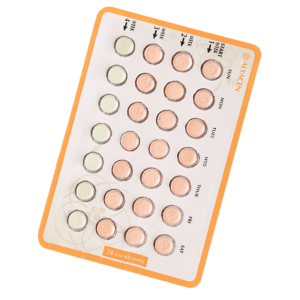
Alyacen is a combined birth control pill. It’s a generic version of Ortho-Novum, which is a pill that’s been discontinued. Because it’s a generic, it’s got a cheaper price but all the rigorous testing of a brand-name medication.
Combined birth control is contraception that combines two hormones, progestin and estrogen. All hormonal birth control will have progestin but some kinds, like the mini pill, don’t have any estrogen.
You’ll take Alyacen every day, at the same time. It’s very effective at preventing pregnancy.[1]
Alyacen 1/35 and Alyacen 7/7/7: what’s the difference?
“1/35” and “7/7/7” refer to the amount of hormones and the way you’ll get them.
Alyacen 1/35 has 1mg of norethindrone acetate (a progestin) and .035mg of ethinyl estradiol (an estrogen).
Alyacen 7/7/7 is a triphasic pill, which means the amount of hormones in the active weeks goes through three phases. For Alyacen 7/7/7, the amount of estrogen stays the same (0.035mg) but the amount of progestin changes. In the first week you get 0.5mg, then 0.75mg in the second week and finally 1mg in your last week before the seven inactive pills.
So: Alyacen 1/35 has the same amount of hormones every week of active pills, and Alyacen 7/7/7 switches up the amount of progestin. Talk to the doctor during your consultation about your options and they’ll help you find a pill that works for you.
How does Alyacen work?
The synthetic hormones in Alyacen change how your body prepares for pregnancy every month. How? In three ways.
The primary one is by blocking ovulation, which is when your body releases an egg that can then be fertilized. The second is by stopping the lining of your uterus from growing thicker. Normally, it would do this so that it’s more comfortable for the egg to embed there and grow. A thinner monthly lining is what gives you the lighter, shorter period you’ll experience with hormonal birth control. And the third way is by physically blocking sperm from swimming to the egg by making the mucus in your cervix thicker. Combined, these three methods make it very, very unlikely you’ll become pregnant.
Treated trusted source:
Kost, K., et al (2008).Estimates of contraceptive failure from the 2002 National Survey of Family Growth. Contraception, 77(1), pp.10–21.
This page was written by The Treated Content Team.
This page was medically reviewed by Dr Alexandra Cristina Cowell on August 25, 2025. Next review due on August 25, 2028.
How we source info.
When we present you with stats, data, opinion or a consensus, we’ll tell you where this came from. And we’ll only present data as clinically reliable if it’s come from a reputable source, such as a state or government-funded health body, a peer-reviewed medical journal, or a recognised analytics or data body. Read more in our editorial policy.
AlyacenNorethindrone Acetate/Ethinyl Estradiol
How to take Alyacen
Alyacen is a daily pill you’ll want to take at the same time every day. That means you should pick a time when you’re likely to be awake and not busy during the entire week. (So if you wake up early on weekdays but like to sleep in on weekends, 8am is not a good time. We like noon; it’s pretty safe.) Take Alyacen with a glass of water and swallow, don’t chew. If you experience an upset stomach while taking Alyacen, try having it with a snack or small meal.
What’s the effectiveness of Alyacen?
It’s up to you. In a perfect world, where everyone takes their birth control pill on time every day, Alyacen will be 99% effective. So if 100 women took Alyacen for a year, one would become pregnant. However, real-world usage brings that number down a little bit because, let’s face it, we’re only human. Sometimes you forget a pill, or take it a bit late. In that case, the effectiveness is more like 91%. So keep a timer on your phone and take your pill on time. Or if the daily thing isn’t working out for you, try a weekly patch or monthly ring instead.
I missed my Alyacen birth control pill
Don’t worry. It happens to the best of us, and missing the occasional pill is even included in studies on how effective hormonal birth control is. The important thing is to get back on track as quickly as possible. You’ll find more detailed instructions in the package insert that comes with your pill, but it usually depends on which pill you missed, how long ago you missed it and what week of your pack you’re in. When you’ve missed your pill, it’s good practice to use back-up contraception (like condoms) for a week to make sure you stay fully protected.
This page was written by The Treated Content Team.
This page was medically reviewed by Dr Alexandra Cristina Cowell on August 25, 2025. Next review due on August 25, 2028.
How we source info.
When we present you with stats, data, opinion or a consensus, we’ll tell you where this came from. And we’ll only present data as clinically reliable if it’s come from a reputable source, such as a state or government-funded health body, a peer-reviewed medical journal, or a recognised analytics or data body. Read more in our editorial policy.
AlyacenNorethindrone Acetate/Ethinyl Estradiol
There are some things you need to watch out for when taking Alyacen, and not everyone can use it.
Here’s the official safety info. If there’s something you’re not sure about, let us know.
AlyacenNorethindrone Acetate/Ethinyl Estradiol
Alyacen: FAQ
Have something specific you want to know? Search our info below, or ask our experts a question if you can’t find what you’re looking for.
What is the generic for Alyacen?
Answer:
Alyacen is actually a generic pill — the brand-name equivalent is Ortho-Novum, which is discontinued. It works as well as a brand-name medication but is likely to be cheaper.
There are other pills which are bioequivalent to Alyacen, meaning they’ve got the same active ingredients in the same amounts.
For Alyacen 1/35, these include Pirmella 1/35, Nortrel 1/35, and Dasetta 1/35. And for Alyacen 7/7/7, they include Nortrel 7/7/7, Necon 7/7/7, Dasetta 7/7/7 and Pirmella 7/7/7.
Is Alyacen low estrogen?
Answer:
Not particularly, though it’s not high-estrogen either. But if you’re looking for a low-estrogen pill, Alyacen may not be right for you.
Alyacen 1/35 and Alyacen 7/7/7 both have .035mg of estrogen (ethinyl estradiol, specifically) in each active pill. Alyacen 1/35 has 1mg of progestin in each active pill, and Alyacen 7/7/7 has a different amount of progestin depending on which week you’re in. Some triphasic pills change up the amount of estrogen rather than progestin, but Alyacen doesn’t.
A low dose of estrogen is generally considered to be .02mg or less. You’ll find that in pills that have “1/20” in their name. Birth control that’s got the same type of estrogen and progestin as Alyacen but a little bit less estrogen include Blisovi 24 Fe and Junel Fe 24 as well as Blisovi Fe 1/20, Junel Fe 1/20 and Microgestin Fe 1/20.
Does Alyacen stop your period?
Answer:
Alyacen probably won’t stop your period, though it should make it lighter and shorter, in addition to more regular. That’s because the “period” you get while taking hormonal birth control isn’t actually a period but something called a “withdrawal bleed” caused by the changes hormones make to your monthly cycle. When your body isn’t preparing for pregnancy every month, it behaves differently — and that results in a shorter and easier period.
Do you want your period to stop entirely? There are several types of birth control that can make it so your period only happens every few months rather than every month. There’s also the hormonal IUD, which stops periods for more women. (You need a doctor to physically insert it, though, so we don’t carry that one.) And, some pills are better than others with alleviating painful periods and might be a better choice for women with endometriosis.
Talk to the doctor about your period during your consultation so they can suggest the best birth control for you.
Does Alyacen cause weight gain?
Answer:
It shouldn’t. Even though we’ve all heard about birth control causing weight gain, none of the studies done to test this have been able to prove a link. But while your birth control won’t cause weight gain directly, there are a few things that could add a few pounds on the scale. Some hormonal birth control causes water retention, especially during the first few weeks of taking it. It’s also possible that it will change your appetite, which can lead to weight gain or loss.
Most birth control side effects should go away by themselves after your body has adjusted to the hormones.[1] Because everybody (and every body) is different, some pills might work better for you than others. If there are specific side effects you’re worried about, let the doctor know during your consultation. And if any come up after you’ve been taking your pill, get in touch.
Is Alyacen a brand-name pill?
Answer:
Alyacen is the generic version of Ortho-Novum, which is now discontinued. Generic medications work just as well as brand-name ones, and are tested just as rigorously. The main difference you’ll find (other than the packaging and the appearance of the pill) is that generics are usually cheaper. So you can rest assured that you’re not missing out on anything.
Will Alyacen help with acne?
Answer:
It can. Most hormonal birth control helps with acne, because the hormones change the amount of oil your skin produces. However, acne is also listed as a possible side effect for most birth control pills, so there’s definitely a chance it could go the other way as well.
If treating acne is important to you, let the doctor know during your consultation. There are some birth control pills that are better at helping acne than others — a few are even FDA-approved to do so.
Is Alyacen the same as Cyclafem?
Answer:
Short answer: yes and no.
Here’s the long answer. Alyacen and Cyclafem are bioequivalent medications, which means they have the same active ingredients in the same quantities, and work in the same way. Since they’re made by different companies, though, they’ll have different packaging, prices and inactive ingredients.
So they’re not identical but if you like one, you’ll probably do well on the other.
Treated trusted source:
Brynhildsen, J. (2014). Combined hormonal contraceptives: prescribing patterns, compliance, and benefits versus risks. Therapeutic Advances in Drug Safety, 5(5), pp.201–213.
Last updated on Aug 25, 2025.
How we reviewed this page:
Our experts continually monitor new findings in health and medicine, and we update our articles when new info becomes available.
Why this page was updated on Aug 25, 2025
'Content checked and updated as part of our 3-yearly periodic review, to ensure accuracy and currentness.'
Current version (Aug 25, 2025)
Edited by: The Treated Content Team.Medically reviewed by: Dr Alexandra Cristina Cowell, Writer & Clinical Content Reviewer
Aug 01, 2022
Published by: The Treated Content Team.Medically reviewed by: Dr Alexandra Cristina Cowell, Writer & Clinical Content Reviewer
How we source info.
When we present you with stats, data, opinion or a consensus, we’ll tell you where this came from. And we’ll only present data as clinically reliable if it’s come from a reputable source, such as a state or government-funded health body, a peer-reviewed medical journal, or a recognised analytics or data body. Read more in our editorial policy.
This is healthcare on your terms.
All from the comfort of your device. Get access to what you need, when you need it.
100% online
Ask questions and get expert recommendations, at the touch of a button.
Tailored choices
We'll narrow down some treatments for you to choose from based on your medical profile.
Secure shipping
Receive your treatment by express delivery, in discreet packaging.
Easy automatic refills
Set your own delivery schedule and pause or make changes any time you like.
We're making healthcare more about you. Sign up to our newsletter for personalised health articles that make a difference.
Disclaimer: The information provided on this page is not a substitute for professional medical advice, diagnosis, or treatment. If you have any questions or concerns about your health, please talk to a doctor.
Dr Alexandra Cristina Cowell
Writer & Clinical Content Reviewer
Cristina writes content for Treated, and reviews content produced by our other writers to make sure it’s clinically accurate.
When we present you with stats, data, opinion or a consensus, we’ll tell you where this came from. And we’ll only present data as clinically reliable if it’s come from a reputable source, such as a state or government-funded health body, a peer-reviewed medical journal, or a recognised analytics or data body. Read more in our editorial policy.
Reviews you can trust
All of our reviews are collected from real patients after their treatment has been delivered.
We publish reviews collected through independent platforms including Reviews.io and Trustpilot.