It’s not recommended to drink alcohol when using Metronidazole.
Even though topical Metronidazole is less likely to cause a reaction than oral Metronidazole, it’s better to be safe and avoid alcohol.

 Express shipping
  US clinicians




Rosacea is a chronic inflammatory skin condition, mostly affecting the facial areas of the cheeks, chin, nose, and central part of the forehead. It can cause various symptoms, mainly redness of the skin, visible blood vessels on the face, and in some cases small, pus-filled bumps. But sometimes a tingling or burning sensation accompanies this, along with dryness of the skin and some swelling.
Anyone can develop rosacea, although it is generally more common in people over 45, women, and people who have fair skin.
Although the exact prevalence of rosacea is unknown, worldwide studies suggest that just over 5% of the adult population is affected. Both men and women are affected by it, but the proportion of women who get rosacea is slightly higher. It mostly affects men and women in the 45-60 age bracket.

How we source info.
When we present you with stats, data, opinion or a consensus, we’ll tell you where this came from. And we’ll only present data as clinically reliable if it’s come from a reputable source, such as a state or government-funded health body, a peer-reviewed medical journal, or a recognised analytics or data body. Read more in our editorial policy.
Although the exact cause is not known, various factors are believed to contribute to or cause rosacea. It may be simply down to skin type (genetics), as rosacea may run in some families, such as those with photosensitive skin types. Exposure to the elements, like the sun, for example, is also seen as a risk factor, along with increasing age.
It’s also thought that a tiny mite (demodex folliculorum), which lives harmlessly on the skin of many people and usually produces normally harmless bacteria, is understood to be more prevalent if you’re more prone to rosacea.
Sometimes, there’s a specific stimulus or trigger that may include the following:
There are various symptoms associated with rosacea. Some or all may be experienced, with the severity and duration varying greatly from person to person and even episode to episode. The first symptom you’ll normally get is redness (blushing) across your nose, forehead, cheeks, and chin, which may come and go. This may be accompanied by a burning or stinging sensation, especially when washing or using skincare products. On darker skin, this redness may be harder to see.
Other symptoms may include:
Usually, rosacea doesn’t cause any serious complications. But if it affects the eyes, it can become serious without treatment. On very rare occasions, it can lead to a serious form of rosacea, called fulminans, which can produce large cysts that may cause permanent scarring.
Rosacea is often misdiagnosed as eczema, and the longer it’s undiagnosed and untreated, the more serious it can become.
How we source info.
When we present you with stats, data, opinion or a consensus, we’ll tell you where this came from. And we’ll only present data as clinically reliable if it’s come from a reputable source, such as a state or government-funded health body, a peer-reviewed medical journal, or a recognised analytics or data body. Read more in our editorial policy.
How we source info.
When we present you with stats, data, opinion or a consensus, we’ll tell you where this came from. And we’ll only present data as clinically reliable if it’s come from a reputable source, such as a state or government-funded health body, a peer-reviewed medical journal, or a recognised analytics or data body. Read more in our editorial policy.

Doxycycline is a tetracycline antibiotic. For rosacea, it’s primarily used for its anti-inflammatory effects, and when topical treatments haven’t been effective.
Prescription-strength gel that reduces inflammation and redness. Contains 15% azelaic acid.

Topical gel that constricts blood vessels near the skin’s surface to reduce redness.
Topical antiparasitic cream you apply once a day. Helps reduce irritation and redness.

Oracea is a low-dose doxycycline capsule used to treat the bumps caused by rosacea.
Relieves swelling and redness, and kills the bacteria that cause rosacea. Also clears dead skin cells to keep your pores clean.
Antibacterial gel to reduce the severity of the symptoms. Generic version of Metrogel.

Registered with NPI (No. 1043478878)
Meet Joseph
Registered with GMC (No. 4624794)
Meet Daniel
Always read the leaflet that comes with your medication and tell us about any side effects you get.
We know health, but you know you.
Our experts tell you what’s safe, but you decide what’s best.
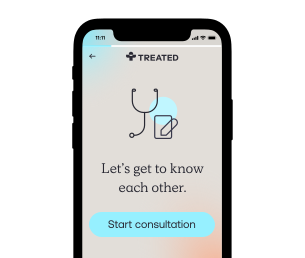
Answer a few questions and tell us about yourself. Get tailored advice from our clinicians so you can choose better.

Choose your treatment and how often you have it delivered.
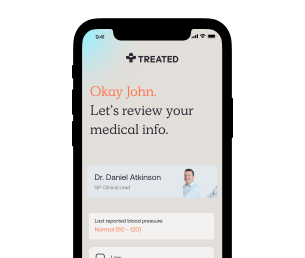
We know things change. It’s the nature of life. We’ll check in regularly to make sure your treatment is still right for you.

Pause. Change. Skip. Start again. Any time you like.
Here are some other things we can help with.
Stop smoking treatments that can help you kick the habit forever, and reduce your risk of disease.
Tablets or injections. Tailored weight loss treatments combined with ongoing support from our experts.
Authorised and Regulated by: