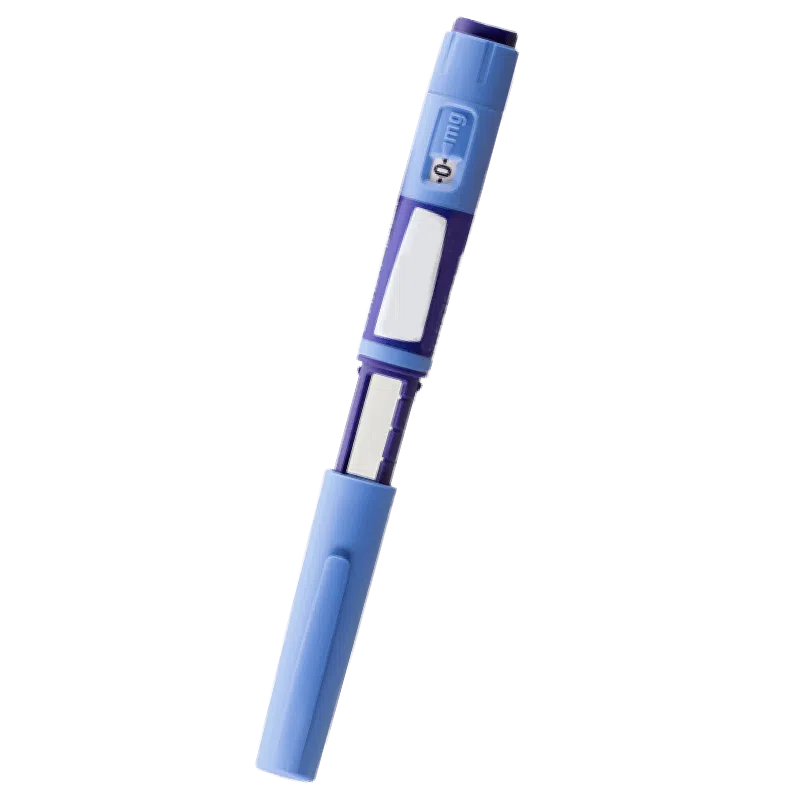
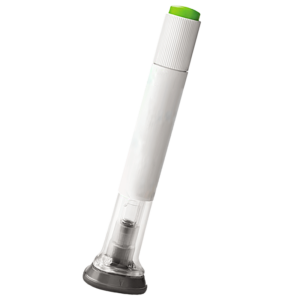
Trulicity is a pre-filled injection treatment for type-2 diabetes. Its active ingredient, dulaglutide, belongs to a group of medicines called GLP-1 agonists, which work to lower your blood sugar and reduce your risk of cardiovascular disease.[1] Research has also indicated that they can help with weight loss, although Trulicity isn’t licensed for this purpose.
While some other injection treatments for type-2 diabetes need to be injected daily, Trulicity is a once a week treatment. So rather than having to plan around taking it daily, you’re free to spend the rest of the week however you want to.
How does Trulicity work?
Type-2 diabetes is a condition that’s usually developed in adulthood, often because your pancreas doesn’t produce as much insulin (a hormone that helps you process sugar) as it should, or because your cells have become less sensitive to insulin. This can lead to concentrations of sugar in your bloodstream that are too high, which can cause you long-term health problems.
Trulicity works to reduce the high blood sugar levels caused by type-2 diabetes by mimicking the action of a hormone that encourages your pancreas to secrete insulin. The higher levels of insulin in your blood then help to move the sugar from your bloodstream into your cells for it to be used as energy.
Overweight and obesity can be risk factors for diabetes, and obesity and diabetes often go hand in hand.[2] It isn’t fully known how GLP-1 agonists support weight loss, but it’s thought that they reduce your appetite and delay the emptying of your stomach, which can make you feel less hungry and eat less.[3]
What doses of Trulicity are there?
Trulicity is available in four doses: 0.75mg, 1.5mg, 3mg and 4.5mg solutions for injection in pre-filled pens. The dose that you’re prescribed will depend on your individual health needs. You’ll probably start on a dose of either 0.75mg or 1.5mg once a week to start off with, which can be increased to 3mg or 4.5mg if your HbA1c (the test of your blood sugar levels over the past 2-3 months) doesn’t seem to be dropping down to your target level.
Treated trusted source:
Kristensen, S.L., et al. (2019).Cardiovascular, mortality, and kidney outcomes with GLP-1 receptor agonists in patients with type 2 diabetes: a systematic review and meta-analysis of cardiovascular outcome trials. The Lancet Diabetes & Endocrinology.
Leong, K.S. and Wilding, J.P. (1999).Obesity and diabetes. Best Practice & Research Clinical Endocrinology & Metabolism, [online] 13(2), pp.221–237.
This page was written by The Treated Content Team.
This page was medically reviewed by Dr Daniel Atkinson on January 22, 2025. Next review due on January 22, 2028.
How we source info.
When we present you with stats, data, opinion or a consensus, we’ll tell you where this came from. And we’ll only present data as clinically reliable if it’s come from a reputable source, such as a state or government-funded health body, a peer-reviewed medical journal, or a recognised analytics or data body. Read more in our editorial policy.
TrulicityDulaglutide
How to use Trulicity
You should always use Trulicity exactly as instructed by our doctor.
Each pen contains one weekly dose of Trulicity, which can only be used once. You can use Trulicity at any time of day, with or without meals, but you should use it on the same day each week if you can. You should inject Trulicity subcutaneously (under the skin) of your upper leg or abdomen. If someone else is injecting you, they can do it on your upper arm. You can inject the same area of your body each week, but you should choose a different injection site within that area from the previous week.
Trulicity should be stored in the fridge.
To use Trulicity:
remove it from the refrigerator, leaving the base cap on
check the label to make sure that it’s correct and unexpired
inspect the pen. Don’t use it if the solution is cloudy or discoloured, or your pen is cracked or damaged
wash your hands
choose your injection site. Make sure that it’s not the same as the previous week
make sure that the pen is locked, and pull off the grey base cap
check that the base cap has been removed properly (there should be a picture in the instructions that come with your medicine). If it has, you can discard it. If the grey cap doesn’t look like it should, don’t use the pen
place the clear base flat and firmly against the skin of your chosen injection site. Unlock it by turning the lock ring
press and hold the green injection button. You should hear a loud click
continue holding the pen in place, firmly against your skin, until you hear a second click
remove the pen from your skin
discard your pen in a sharps container or as otherwise directed to by your doctor.
How long does Trulicity stay in your system?
Trulicity has a half-life (the time it takes for half of the drug to leave your system) of around five days.[1] Typically, it takes around five half-lives for a drug to completely leave your system, meaning that traces of Trulicity might be found in traces for around 25 days after you take it. This doesn’t mean that it’s active in your system for this amount of time, though. You’ll still need to take it weekly for it to continue to have an effect on your body.
What should I do if I make a mistake when using Trulicity?
If you accidentally use more Trulicity than you should’ve done, seek medical help straight away. Taking too much of it can cause hypoglycaemia, where your blood sugar levels are too low. It can also make you feel or be sick.
If you forget to use your dose of Trulicity, you can do so when you remember, so long as it’s not less than three days until your next scheduled dose. If there are less than three days to your next dose, skip the forgotten one and continue with your regular schedule. Don’t double the dose to make up for the missed one.
Treated trusted source:
Geiser, J.S., et al. (2016).Clinical Pharmacokinetics of Dulaglutide in Patients with Type 2 Diabetes: Analyses of Data from Clinical Trials. Clinical Pharmacokinetics, [online] 55(5), pp.625–634.
This page was written by The Treated Content Team.
This page was medically reviewed by Dr Daniel Atkinson on January 22, 2025. Next review due on January 22, 2028.
How we source info.
When we present you with stats, data, opinion or a consensus, we’ll tell you where this came from. And we’ll only present data as clinically reliable if it’s come from a reputable source, such as a state or government-funded health body, a peer-reviewed medical journal, or a recognised analytics or data body. Read more in our editorial policy.
TrulicityDulaglutide
Trulicity isn’t suitable for everyone, and there are some things that you need to be aware of when taking it.
Here’s all the official info on it. If anything is unclear, let our clinician know, and they can talk with you about it.
TrulicityDulaglutide
Trulicity: FAQ
Have something specific you want to know? Search our info below, or ask our experts a question if you can’t find what you’re looking for.
How is Trulicity different from other treatments for diabetes?
Answer:
Diabetes treatments come in a range of different types. Typically you’ll be prescribed metformin to start off with, unless it’s not suitable for you. If metformin on its own doesn’t work to control your blood sugar, you’ll move onto a different type of treatment, which will probably be used alongside metformin. The most common types of treatment for diabetes are typically: DPP-4 inhibitors, SGLT-2 inhibitors, glitazones or sulfonylureas.
Each type of treatment has a different mode of action in order to lower your blood sugar, and it can sometimes take a bit of trial and error to find the one that works best for you.
Trulicity differs from most diabetes treatments in that it’s a once-a-week injection treatment, whereas most other diabetes treatments come in the form of daily tablets. You might find it better to use a weekly injectable like Trulicity if you struggle to swallow tablets, or find it inconvenient to take daily treatment.
Is Trulicity similar to any other treatments?
Answer:
Other GLP-1 agonists include:
Liraglutide (sold under the brand name Victoza)
Exenatide (Byetta, Bydureon)
Tirzepatide (Mounjaro, Zepbound)
Semaglutide (Ozempic, Rybelsus)
Rybelsus is the only one of these which is available as an oral (tablet) treatment. The rest are pre-filled injections.
Ozempic, Mounjaro, Zepbound and Bydureon are also once-a-week treatments, whereas Victoza, Byetta and Lyxumia need to be injected daily.
Does Trulicity cause hair loss?
Answer:
Although some people have claimed that Trulicity has caused hair loss for them, there’s no scientific evidence that this is the case. There is, however, evidence to suggest that having diabetes can cause hair loss. [1]
Do I need a prescription for Trulicity?
Answer:
Yes, you need a prescription for Trulicity. This is because it’s not a suitable treatment for everyone, and your condition will need to be monitored whilst you’re using it to make sure it continues to be safe and effective for you.
Treated trusted source:
Zubair, S. and Mujtaba, G. (2009).Hair – a mirror of diabetes. Journal of Pakistan Association of Dermatologists, [online] 19(1), pp.31–33.
Last updated on Jan 21, 2025.
How we reviewed this page:
Our experts continually monitor new findings in health and medicine, and we update our articles when new info becomes available.
Jan 21, 2025
Published by: The Treated Content Team.Medically reviewed by: Dr Daniel Atkinson, Clinical Reviewer
How we source info.
When we present you with stats, data, opinion or a consensus, we’ll tell you where this came from. And we’ll only present data as clinically reliable if it’s come from a reputable source, such as a state or government-funded health body, a peer-reviewed medical journal, or a recognised analytics or data body. Read more in our editorial policy.
This is healthcare on your terms.
All from the comfort of your device. Get access to what you need, when you need it.
100% online
Ask questions and get expert recommendations, at the touch of a button.
Tailored choices
We'll narrow down some treatments for you to choose from based on your medical profile.
Secure shipping
Receive your treatment by express delivery, in discreet packaging.
Easy automatic refills
Set your own delivery schedule and pause or make changes any time you like.
We're making healthcare more about you. Sign up to our newsletter for personalised health articles that make a difference.
Disclaimer: The information provided on this page is not a substitute for professional medical advice, diagnosis, or treatment. If you have any questions or concerns about your health, please talk to a doctor.
Dr Daniel Atkinson
Clinical Reviewer
Dr Daniel is a UK doctor who reviews medical content across the site to make sure it's clinically accurate. On specific pages he's reviewed you'll see his reviewer card.
When we present you with stats, data, opinion or a consensus, we’ll tell you where this came from. And we’ll only present data as clinically reliable if it’s come from a reputable source, such as a state or government-funded health body, a peer-reviewed medical journal, or a recognised analytics or data body. Read more in our editorial policy.
Reviews you can trust
All of our reviews are collected from real patients after their treatment has been delivered.
We publish reviews collected through independent platforms including Reviews.io and Trustpilot.