
Finding your feet with exercise and weight loss injections
Wondering how to get started with exercise? Look no further - your definitive guide

If you’ve started using a weight loss injection, you’ll have been told to do so alongside healthier diet choices and increased exercise. Eating a wider variety of whole foods, such as fruit, nuts, healthy fats and lean protein is a vital step on your weight loss journey which can help you feel better both mentally and physically.
For some people, changing how they eat might feel like the easy part of their new weight loss plan. Often, it’s packing regular exercise into a busy schedule that proves challenging.
Exercise has many benefits beyond helping you get in shape. It can improve your sleep, increase your energy, regulate your appetite and help you avoid stress and mood disorders such as depression.[1] With all that in mind, shouldn’t it be easy to lace up your running shoes and head to the nearest park? On paper, yes. But the reality of fitting exercise into your plans isn’t always so simple.
If you’ve had a long stint off regular workouts, or you’re approaching exercise as a newcomer who hasn’t done much before, it’s important to find your feet and do what feels right for your current fitness level. Overdoing it before you’re ready can cause fatigue, and might put you at risk of a more serious injury that means you can’t do any of the activities you want to.
Start at the beginning and ease yourself into a routine you’re comfortable with. That’s not to say you can’t pack in mood-boosting runs or strength-building workouts, but going too big too soon could hamper your long-term weight loss goals. Listen to your body, and discuss your exercise routine with a clinician so they know it’s safe for you to do while using your treatment.
Getting started with exercise
Taking the first steps towards regular exercise can be daunting for a lot of people. Whether you’re starting from scratch or dusting off your old gear, knowing how to get yourself going can be tricky.
So where do you begin? Talking to a doctor about exercise levels might be the best first step. Building yourself up gradually could be key to knowing where you’re up to in terms of working out while using your injections.
While not everyone gets side effects from weight loss pens, they do change how your body works. This means that, depending which treatment you use, you’ll be experiencing hormonal and appetite changes that need to be considered before you exercise.
Wegovy, for example, has the potential to cause dehydration, because one of its listed side effects is diarrhea.[1] This could be made worse by sweating during a workout, so it’s important to hydrate properly and listen to your body.
Once you’ve got a good handle on how your body responds to exercise while using your pen, you can gradually start to increase the amount you do.
What exercises should I be doing?
If it’s been a while since you last exercised, aim to try a beginner workout first.
By easing yourself back into regular exercise, you can build your strength and stamina gradually. It’s also important to enjoy the activity you choose to do — forcing yourself to do workouts you don’t like doing means going back to them can feel like a chore.
We’ve mentioned the benefits exercise has on mood and sleep patterns, so trying to remember that what you’re doing isn’t all about losing weight. Regular workouts can improve your energy levels,[2] which in turn can motivate you to increase the intensity of your routines, or do them for longer.
Having improved energy levels will help you feel better all-round. It can improve your sense of wellbeing and help reduce stress,[3] which can help you feel positive about your weight loss journey. The more energy you have, the more motivated you’ll feel to stay focused on your goals.
At home beginner’s workout plan:
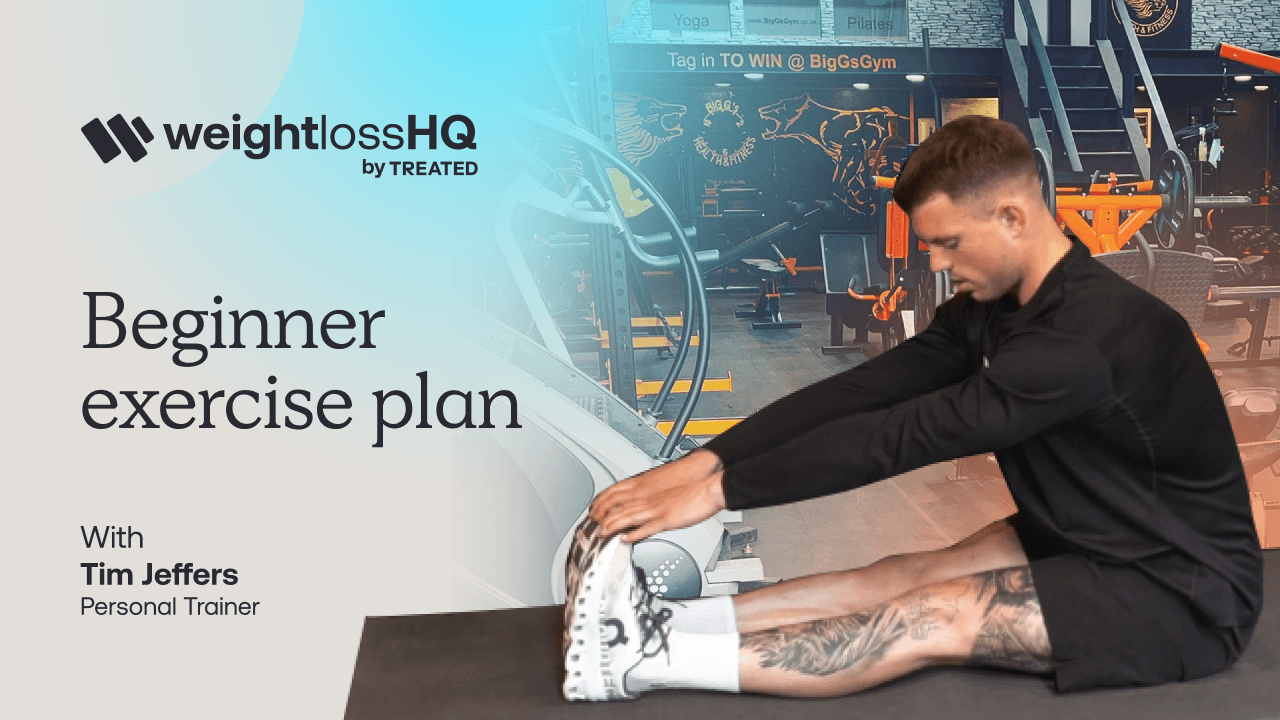
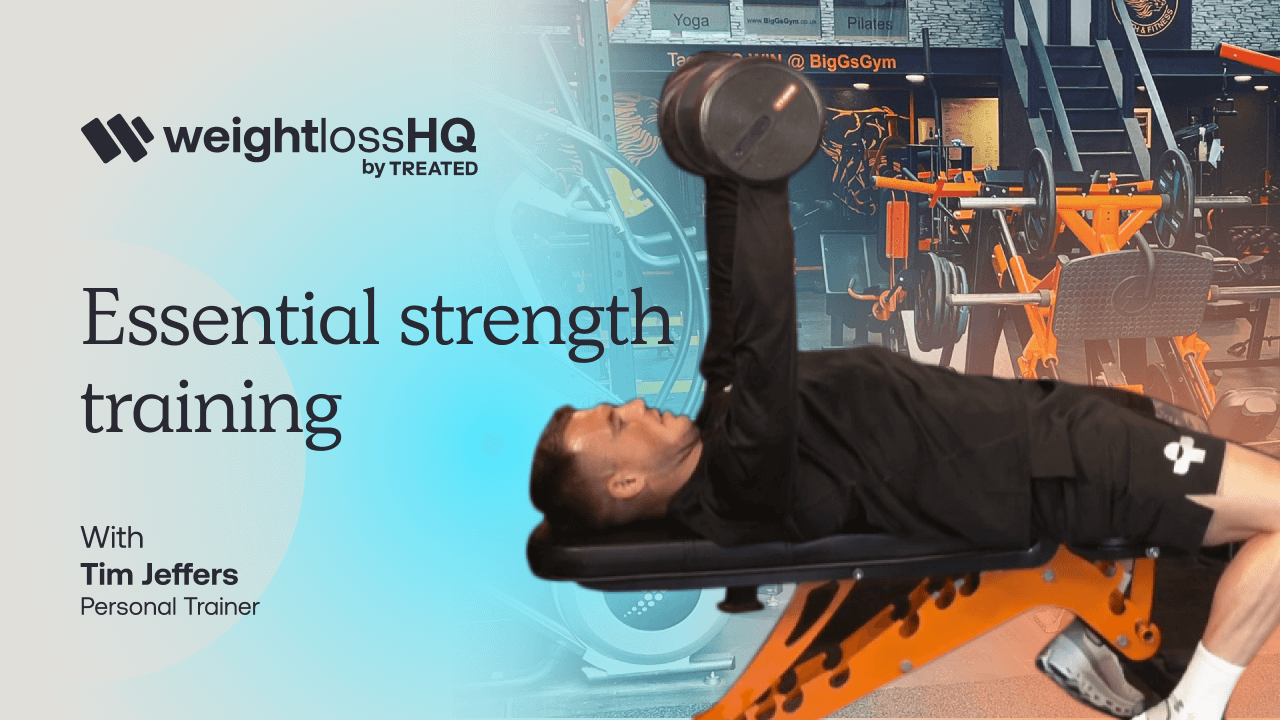
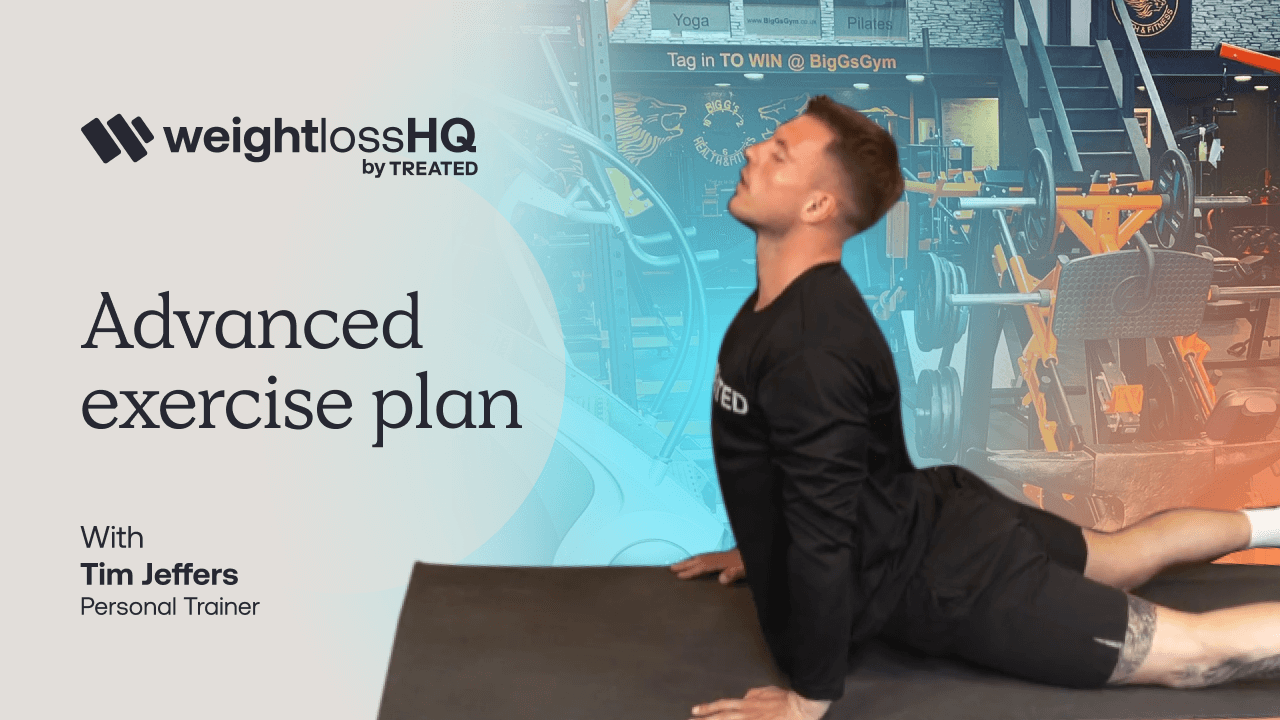
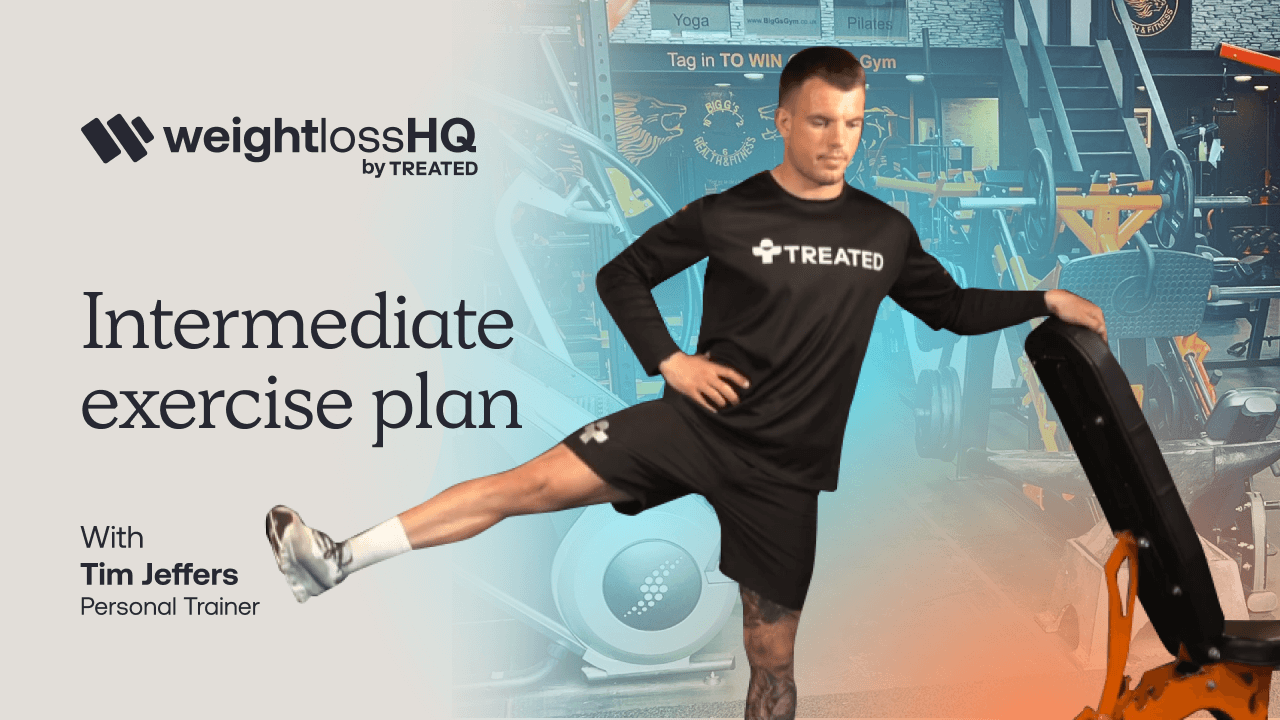
To help you get inspired, we’ve collaborated with professional rugby player Tim Jeffers and put together a series of workouts for you to try at home. You can start with this one, and then when you’re ready, move on to the intermediate and advanced plans.
When you’re using weight loss injections like Wegovy and Saxenda, sticking to a regular exercise plan is a great way of improving your overall health while moving towards your target weight.
For this plan, you’ll only need three things — a yoga mat, some resistance bands, and a sturdy chair.
Aim to do this plan three days a week. You might find having a rest day between each session helps you recover, but how you get the workouts in is up to you. To begin with, do the exercises for around 15-30 minutes each time. When you’re feeling fitter, you can up the amount of time you do them for.
Your warm up
Before you do any workout, it’s important to warm up. Warming up can help you avoid picking up any injuries by working muscles before your body is ready.
First, march on the spot for two minutes. This will help you get coordinated for the exercises while getting your heart rate up.
Next, do some arm circles for one minute. The idea here is to loosen up your arms and shoulders by increasing blood flow.
Leg swings: This is a dynamic stretch that uses your full range of motion. You might have seen runners doing it before a race. Hold onto the chair, keep your legs loose, and be mindful of not overarching your back. Do these for one minute.
Finally — shoulder shrugs for one minute. Shoulder shrugs activate your trapezius muscles, which is ideal before an upper body workout.
Your workout
Squats to chair
Keep your feet about shoulder width apart as you stand in front of a chair. Aim to keep your bottom back and bring your chest forward as you lower towards the chair. Gently lower yourself down and when your buttocks touch the chair, stand back up.
Repeat this 8-10 times.
Chair squats target your hamstrings and glutes while working on your core strength.
Wall push-ups
This exercise is exactly what it sounds like — you’re going to do a push-up, but against a wall.
These are a great way of working your chest muscles from an upright position.
Facing the wall, place your hands shoulder width apart on it, bend at the elbows to bring your face slowly towards the wall, and extend your arms again. Repeat 8-10 times.
Seated leg extensions
Sit on a chair and extend one leg out in front of you, trying to activate your core as you do.
Repeat this 8-10 times.
Extensions like this can help you strengthen your quadricep muscles, which will get you set up for more advanced core exercises down the line.
Banded pull-aparts
For this exercise, you’ll need your resistance band. Hold the band out in front of you, and slowly pull it apart while keeping your arms straight.
The key here is form — while extending your arms as far apart as you can, try to squeeze your shoulder blades together.
Banded pull-aparts help to strengthen your shoulder cuffs, which play a big part in most shoulder movements. Do 8-10 reps.
Plank from knees
Planking is a great all-rounder — it can improve backache, and is a powerful core strength builder (even though there isn’t any movement involved).
Lying on your mat, form a plank position while keeping your knees on the ground. Maintain a straight line from your head down to your knees.
Hold this position for about 20-30 seconds.Your core muscles might be weak to begin with, but they’ll build every time you plank.
Your cool down
Cooling down is equally as important as warming up. It can reduce muscle soreness and help ease your heart rate back to its normal level.
First up is the seated forward bend. Sit on your mat with your legs fully extended. Hinge at the hips, and reach towards your toes. Ease into this one as you stretch your shoulders, back, and hamstrings.
Next up is an upper back stretch. Using your chair, clasp your hands in front of you and round your upper back.
The third stretch is all about opening your chest. You can stand or sit for this one. Clasp your hands behind your back, and raise your arms as you feel the chest open.
The last part of the cool down is a neck and shoulder stretch. Gently tilt your head to one side and feel the stretch in your neck. Do the same for the other side. Follow these up with some easy shoulder rolls.
What are low-impact exercises?
Low-impact exercises are workouts that don’t put too much strain on your muscles and joints. But that’s not to say they’re less essential than high-intensity ones. Low-impact exercises are a great way of burning calories without causing too much fatigue, and are perfect for maintaining fitness while avoiding injuries or overtraining.
Walking
Often overlooked as a form of exercise, walking can help you build stamina, burn calories and fight heart disease.[4]
If you need to go somewhere, skip the car and use it as an excuse to get some steps in. If you have a smartphone, you can use it to track your steps.
Swimming
Swimming can almost be considered a zero-impact exercise. Like walking, it can improve your stamina while building your lung capacity. It’s also heart-healthy, and is a great way of building muscle tone without the need for weights.
Light yoga
If you’ve never done yoga before, it can feel daunting. Practice makes perfect, though, and your body will thank you for including some light yoga as part of your workout routines.
Yoga can help build your core strength, while the stretching involved can relieve muscle soreness and help you prevent future injuries.
Stationary cycling
Stationary cycling has all the benefits of using your bike on the road, minus navigating traffic or potholes. A session will help strengthen your legs, while boosting your cardiovascular fitness.
Because stationary bikes allow you to set the resistance level, you can increase the intensity of your workouts, or lower them if you want a gentler recovery session.
Why is strength training important?
While you’re losing weight and feeling healthier overall, you might not necessarily be getting physically stronger. This is because weight loss can lead to a loss of muscle mass. Sarcopenia is the medical term for low muscle mass and impaired muscle function,[5] and it can occur as your treatment helps you get slimmer.
Eating lean proteins can help you maintain your muscle strength, but if you want to build it up, you’ll need to incorporate some strength training into your workouts.
Even as you reduce the amount of calories you’re consuming, you can still build muscle mass by using weights or exercises that involve resistance training. There are lots of exercises, such as yoga, that can build muscle while using your body weight alone.
Staying strong can reduce your risk of injury, maintain your metabolic rate, and perform a variety of daily tasks more easily. It can also help you avoid injury as you increase the amount of exercise you do.
Tips on staying motivated
Once you begin exercising regularly, you should start to feel better both physically and mentally. Setting goals each week is a useful way of staying motivated and sticking to your workout routines.
At the same time, it’s good to be realistic about what you want to achieve. If you put too much pressure on yourself to hit your targets, you might feel the need to overdo it, or ignore your body’s cues for rest and overtrain—which can be counterproductive when it leads to burnout or injury. It’s important to enjoy the journey you’re on, so don’t give yourself a hard time if you skip the odd workout. If some days you don’t feel like you’ve got a workout in you, try a lighter, low-impact exercise that will burn some calories without pushing you too much. Something’s still better than nothing.
Rest is important when you’re exercising regularly, and fueling your body is a big part of this. Hydrate properly and eat a balanced diet, and you’re more likely to feel prepared for the next workout that comes along.
- Uchiyama, S., Sada, Y., Mihara, S., Sasaki, Y., Sone, M., & Tanaka, Y. (2023). Oral Semaglutide Induces Loss of Body Fat Mass Without Affecting Muscle Mass in Patients With Type 2 Diabetes. Journal of Clinical Medicine Research, 15(7), 377-383.
- NHS. “Self-Help Tips to Fight Tiredness.” Nhs.uk, 27 Jan. 2022.
- Farhana, A. and Rehman, A. (2024). Metabolic Consequences of Weight Reduction. [online] PubMed.
- Cava, E., Yeat, N.C. and Mittendorfer, B. (2017). Preserving Healthy Muscle during Weight Loss. Advances in Nutrition: An International Review Journal, 8(3), pp.511–519.
- NHS (2022). Walking for health. [online] nhs.uk.
When we present you with stats, data, opinion or a consensus, we’ll tell you where this came from. And we’ll only present data as clinically reliable if it’s come from a reputable source, such as a state or government-funded health body, a peer-reviewed medical journal, or a recognised analytics or data body. Read more in our editorial policy.
Share your thoughts.
Was this info helpful?