
Social support: how it can help when exercising to lose weight
Better together: How to harness the power of your peers to boost your progress.
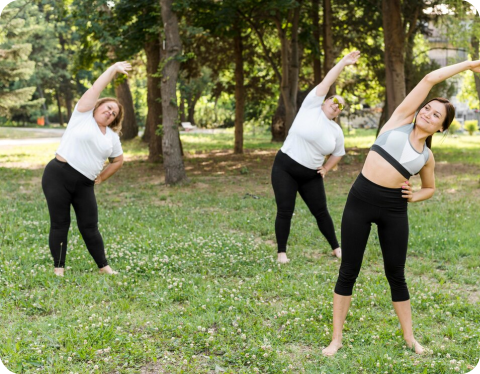

A study by a popular UK gym chain reported that 55% of the UK population said they don’t exercise.1
Many of us recognise that being sedentary is bad for our health. We acknowledge that exercise can help our brain and our body.2 But as this statistic suggests, many people still struggle to make exercise a regular commitment.
An effective way to overcome this lack of commitment is to create a supportive environment for yourself. Studies show that a supportive social environment can lead to increased levels of exercise and motivation.3 So whether it’s an online support group or an exercise partner (or both), finding that support is key.
What are the benefits of social support when exercising?
Having support around you when exercising can be motivating. It can encourage you to perform better and help to hold you accountable. It can also be more fun when you’ve got someone to exercise with. You might find a tough set of squats to be much easier with a friend cheering you on. One study found that older adults who regularly participated in regular group exercise had improved mental, physical and social well-being. 2 Also, making exercise fun can help habits stick, which can lead to long-term lifestyle changes.
Staying motivated
Finding the motivation to exercise can be tough. If only the adrenaline and enthusiasm you had when you first started exercising stayed with you. One effective way to foster this motivation is to build a support system by working out together. Whether it’s with a friend for a morning jog or attending a pilates class, knowing someone is joining you can be just the push you need to get moving, even on those days when you’d rather stay in bed.
Exercising with others might improve your exercise experience, especially if you feel supported by them. Studies have found that exercising together increases the amount of exercise you do, with even greater benefits seen when there’s emotional support from your exercise partner.5 So whether it’s because they’re encouraging you to go the extra mile or engaging in a bit of friendly competition, achieving your fitness goals can be much more engaging with a workout buddy than going solo.
Accountability
Many of us have probably cancelled gym plans or skipped the morning workout class because we weren’t quite in the mood. When you’re on your own, the only person you disappoint is yourself. One way to commit to your fitness goals is to make plans with an exercise buddy. This commitment inherently creates a sense of accountability. Knowing someone is counting on you can give you the mental boost needed to show up.
When you agree to meet with someone at a specific time and place, you might be less likely to bail out. It forces you to show up and exercise. And it goes both ways: if your exercise partner doesn’t show up, it’s up to you to hold them accountable.
Don’t take it to the extreme, though. Maintaining discipline is good so long as it doesn’t come at the expense of other important parts of your health and your life. Forcing you or your friend to persevere through injury, for example, isn’t a healthy way to approach your fitness goals.
Sharing practical tips
Teaming up with a partner or joining a fitness group also means you can help each other out through ‘spotting’ or sharing advice on technique or training tips. This can enhance your fitness routine, improving the effectiveness of your workouts. Additionally, learning from someone with experience can provide valuable insights and personalised guidance, further enhancing your progress.
Making exercise more fun
Exercising alone can sometimes feel monotonous, but pairing up with a friend or joining a group can make it more enjoyable. When you exercise, your body releases chemicals called endorphins, which act as natural pain relievers in response to stress or discomfort. Endorphins can make you feel good and improve your overall mood. Exercising with a partner can increase the amount of endorphins, making you feel even better. This was demonstrated in a study that found exercising with a companion enhances mood and mental health, compared to solo exercise.6 It also found that social connections formed through exercise positively contributed to overall psychological well-being.
Moreover, exercising with your partner can make your romantic relationship healthier. Spending quality time together, being there for each other physically and emotionally, and sharing the same fitness goals contribute to a stronger bond.
Improving physical and mental health
While studies show that group exercise tends to increase the amount of physical activity you do per session, which can make you healthier and fitter,5 studies also indicate that those who exercise in groups have better attention, memory, and overall cognitive functions. These benefits can lower your risk of degenerative disorders like dementia and Alzheimer’s. Furthermore, group exercise can provide psychosocial benefits through social relationships, improving physical and cognitive functions.7
What are the different types of social support for exercise?
Social support is defined as care and assistance provided by a network of people, including family, friends, and community members. There are four main types of social support:8
- Emotional support, such as empathy shown during exercise.
- Instrumental (tangible) support, which involves practical help. In the context of exercise, this could include structured group sessions, equipment sharing or online workout classes.
- Informational support, which provides access to knowledge. This could involve online videos about exercises or blogs.
- Appraisal support, which involves feedback and words of affirmation. In the context of exercise, this might include a personal trainer correcting your form or a friend helping you with a technique.
Every individual will have varying needs for social support, so each person’s support system will look different. But it’s clear that having even some support can be highly motivating. If you’re looking to build your support network, here are some tips on how to create these support systems:
Buddying up
Pairing up with a friend to exercise, whether it’s a weekly run or a commitment to join the gym together, can be encouraging. You might feel less self-conscious about exercising with someone you know. For instance, if you want to try some new gym equipment or take a class, having a friend there with you can make you feel less alone.
You can even have a friendly competition if they share the same goals as you, so you can push one another to reach your goals quicker. Additionally, you’ll be able to help each other if your form is off or you need a spotter.
One thing to note is making sure you’re compatible with their fitness levels. This way you can push each other, without one going ahead or being left behind.
Exercise groups
If you don’t have a workout friend, joining an exercise group (such as a running club, exercise class or sports team) can have some of the same benefits as buddying up. Agreeing to meet at a set time encourages compliance and motivates you to attend. Exercise clubs often have social communities alongside the workouts too, further helping to integrate you into a healthy routine.
There are even online sports groups you can join, if you’re struggling to find one local to you. Some of these include indoor cycling workouts, pilates, and yoga classes. Even though they might not feel quite as social or immersive as the ‘real deal’, they can be just as motivating.
Fitness apps
Fitness apps, or workout apps, can help keep your commitment to your fitness goals. They often have a wide range of workout classes in different durations, so even if you only have 10 minutes to workout before work, you’ll find a session that suits you.
Some might have a monthly subscription fee, but you can always find free workouts on YouTube. Be mindful of relying solely on apps, though, as they can lack the personalised guidance or real-time feedback you might get from a fitness professional.
You can also use apps to track your fitness levels, such as Apple fitness or Strava. If you’re a runner, an Apple watch can monitor your miles, heart rate and speed. It can also track cycling, walking and weight lifting. Seeing how much you work out can motivate you to work out every day.
Videos, blogs and books
If you’re not a pro at working out, books, blogs and videos can be very helpful. They can teach you how to correct your form, get started or even give a general insight on exercising.
Researching how to exercise can make it less daunting when you go to the gym or begin a workout class for the first time. It can make you feel more prepared, giving you greater confidence.
If you’re looking to create a customised workout plan, whether it’s for running or for the gym, there are both free and paid options available. Some paid options may even include a consultation with a fitness professional, who can help create a plan specifically tailored to your goals and fitness level.
Online communities
Joining online forums and following fitness social media accounts is another way you can feel connected with people on a similar fitness journey. And you can often find helpful tips and advice there, too. So if you ever find yourself stuck, you can ask for help on online forums or read personal experiences in comments.
How to make social support work for you
Social support can be a powerful tool in your exercise journey. But using it to its full potential can require some effort. First, identify your needs. So if, for instance, you’re new to working out—informational support might be the best place to start.
It’s also good to be selective when making new connections. Not everyone will support your journey, some might even hinder your progress. Additionally, support is a two-way street, so try to offer that same support to those who have helped you.
By implementing these, you’ll create a social support environment that works for you over the long-term. Helping to make you feel physically and mentally stronger in your fitness journey.
- PureGym (2023). The UK Fitness Report – 2022/23 Gym Statistics. [online] PureGym.
- Komatsu, H., Yagasaki, K., Saito, Y., & Oguma, Y. (2017). Regular group exercise contributes to balanced health in older adults in Japan: A qualitative study. BMC Geriatrics, 17.
- Martire, L.M. and Franks, M.M. (2014). The role of social networks in adult health: Introduction to the special issue. Health Psychology, [online] 33(6), pp.501–504.
- Mahindru, A., Patil, P., & Agrawal, V. (2023). Role of Physical Activity on Mental Health and Well-Being: A Review. Cureus, 15(1).
- Rackow, P., Scholz, U., & Hornung, R. (2015). Received social support and exercising: An intervention study to test the enabling hypothesis. British Journal of Health Psychology, 20(4), 763-776.
- Kanamori, S., Takamiya, T., Inoue, S., Kai, Y., Kawachi, I., & Kondo, K. (2016). Exercising alone versus with others and associations with subjective health status in older Japanese: The JAGES Cohort Study. Scientific Reports, 6.
- Fujii, Y., Seol, J., Joho, K., Liu, J., Inoue, T., Nagata, K., & Okura, T. (2021). Associations between exercising in a group and physical and cognitive functions in community-dwelling older adults: A cross-sectional study using data from the Kasama Study. Journal of Physical Therapy Science, 33(1), 15-21
- www.med.upenn.edu. (n.d.). Health Behavior and Health Education | Part Three, Chapter Nine: Key Constructs Social Networks.
When we present you with stats, data, opinion or a consensus, we’ll tell you where this came from. And we’ll only present data as clinically reliable if it’s come from a reputable source, such as a state or government-funded health body, a peer-reviewed medical journal, or a recognised analytics or data body. Read more in our editorial policy.


Share your thoughts.
Was this info helpful?