
Building confidence with exercise
Becoming more comfortable with exercise? Here’s how you can step things up.

Regular exercise is an essential part of any weight loss programme. As well as helping you reach your target goal, a good workout plan can build strength, boost your mood and raise your energy levels.
If you’re exercising often while using a weight loss injection, your confidence will start to grow as your fitness improves and your weight comes down. Before long, you’ll feel less like a beginner when you’re doing your reps.
The next stage of your journey is to build on the routines you already know by adding in some fresh exercises that are slightly more intense.
Stepping up
Whether you’re an exercise newbie or a former seasoned athlete, it’s wise to ease yourself in with programmes designed for beginners. It’s a good way of adjusting, or readjusting, to regular workouts. And it’s also a good measure of seeing how you respond to exercise while using your weight loss injection.
Once you’re used to doing low-intensity reps often, as with all routines, you might find yourself looking for a new challenge. If you’re not stimulated, or feel like there’s no novelty in what you’re doing, it’s natural for a bit of boredom to set in.[1] The fitter you feel, the more likely you are to want to take things to the next stage.
With improved strength and stamina, you can think about pushing yourself and testing your capabilities. If this sounds like you, then it could be time to try a new exercise plan.
Exercising at home to build confidence
To help you get on your way to improved fitness, we’ve collaborated with professional rugby player Tim Jeffers and put together a series of at-home workouts for you.
This exercise programme is the second one, our intermediate plan. If you tried our beginner’s programme, you’ll be familiar with how to approach the circuits. Start with a warm up, work your way through the exercises, then finish with some cool down stretches.
You should aim to do this routine at least four times per week, with rest days in-between so your body can recover. It might seem like a lot at first, but the more you work your way through, the more conditioned you’ll feel to handle this programme.
This workout should take around 20 to 40 minutes. You’ll need a yoga mat, resistance bands, light dumbbells and a sturdy chair. If you don’t have a yoga mat, a soft space on your floor will work just as well.
When you’re picking a weight for your dumbbells, always start light. Use a weight you know you can do for 10 or 15 reps with before you think about increasing.
Your warm up
Get started by jogging on the spot for two minutes to get your heart pumping. Remember to raise your knees as high as you can on each stride – it’ll help you warm up faster, and burn more calories.
Next, move onto some arm swings. Stand with your feet shoulder-width apart and your arms at your sides. Swing your arms forwards and backwards in small motions to get used to the movement, and work your way up until you’re swinging your arms in circular motion about your shoulers. Do this for a minute.
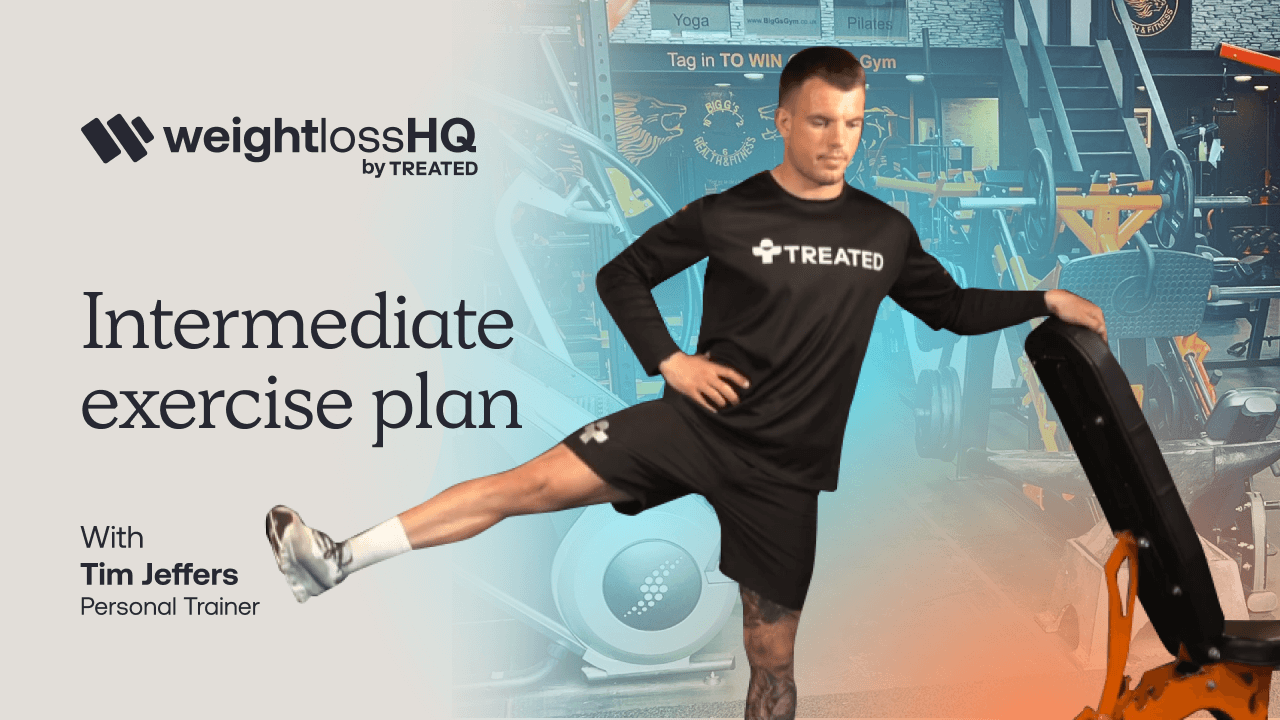
After that, do some side leg raises. Stand up straight with your feet together, and hold onto a chair for support. Slowly raise one leg up to the side, hold it for a second, and then lower the leg. Repeat this on both legs for one minute.
To finish your warm-up, do some shoulder rolls and arm crosses.
For shoulder rolls, start standing up straight. Raise your shoulders in a shrugging motion towards your ears. Then, pull your shoulders back by squeezing your shoulder blades together, and engage your back muscles to pull your shoulders back down. Return to the position you started in, and repeat for one minute.
For arm crosses, push your chest out, and stretch your arms out to either side. Then, rotate your shoulders to move your arms in an arc in front of you, until they cross over. Reverse this movement until you’re reaching out to the sides again, and repeat for one minute.
Once you’re warmed up, you’re ready to try the circuit.
Your workout
Aim to complete this programme three times, and rest for one minute in between circuits.
Body weight squats
Stand with your feet a little wider than shoulder width apart, with your toes pointing outwards slightly.
As you breathe in, hinge your hips in a “sitting” motion. Then, bend your knees to lower yourself into a squat. Raise your arms to be level with your shoulders to help keep your balance as you lower yourself.
Exhale as you push with your heels to stand back up, and lower your arms back to your sides.
Repeat for 10 to 12 reps.
Incline push ups
Stand with your feet hip-width apart, facing a “base” for your incline push ups. This might be a table or a bench – it’s best if this is level with your sternum.
Lean forward and place your hands on your basewall, keeping your arms straight (with a slight bend in your elbows). Bend your arms to slowly lower yourself towards your basewall, until your chest barely touches it. Try to bend your arms at a 45 degree, instead of straight out to the side.
Slowly push back up away from your base until you’re back in your starting position.
Repeat for 10-12 reps.
Standing leg curls
Place your resistance band around both of your ankles, and stand up straight with your feet hip width apart.
Keep both of your knees level while you bend one leg backwards. Push your heel back towards your glutes.
Repeat for 10 reps per leg.
Banded rows
Put your resistance band around a sturdy post, and hold both ends slightly narrower than shoulder width apart.
Slowly pull the band towards your mid section, and pull your hands slightly apart as you get close.
Repeat for 10-12 reps.
Side plank
Lie on your side with your legs extended, one stacked on top of the other, and your head in line with your spine. Prop yourself up with your elbow directly beneath your shoulder, and let your forearm point away from you.
Lift your hips off the mat, so your weight is supported by your elbow and the side of your foot – keeping your body in a straight line.
Hold this position for 20 seconds, and then swap and repeat for your other side.
Dumbbell shoulder press
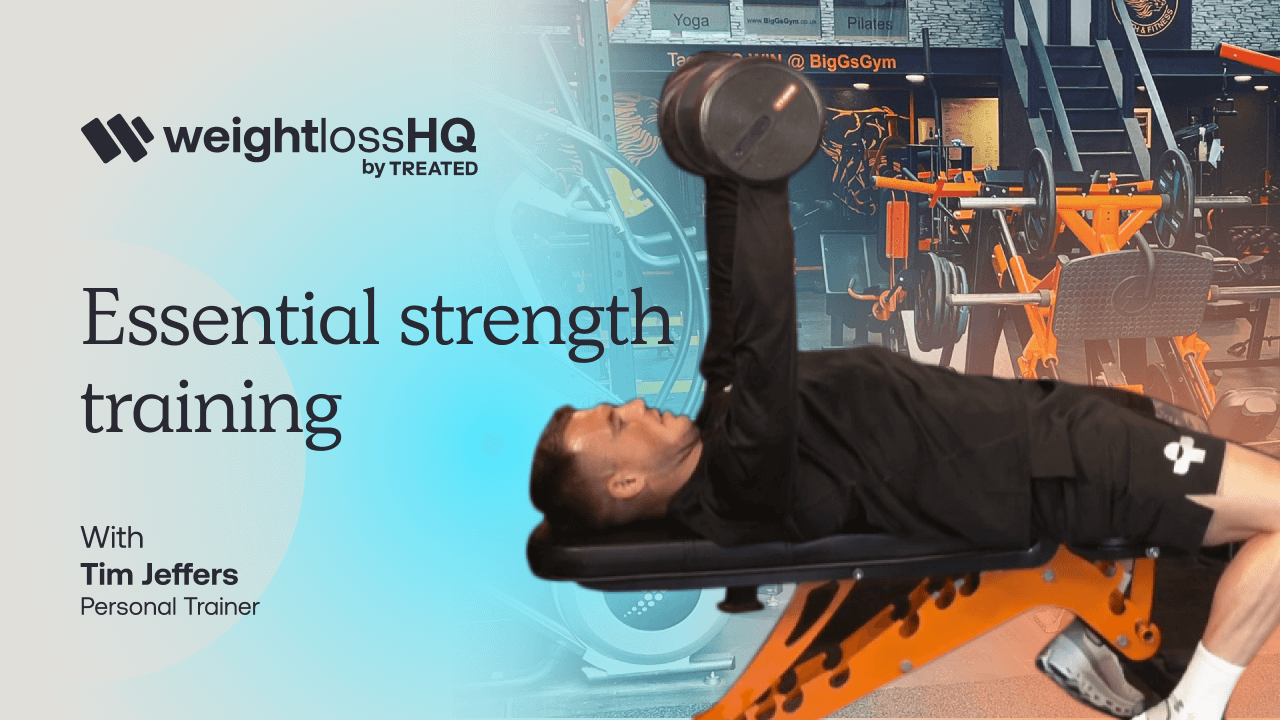
Take one dumbbell in each hand, and stand with your feet shoulder width apart. Lift the dumbbells into a starting position between your shoulders and ears, with your palms facing away from you.
Extend your arms and press the dumbbells over your head, trying to keep them level and your feet flat on the floor. Slowly lower the dumbbells back to your starting position.
Remember to keep your body upright and stable throughout the movement.
After you’ve repeated the circuit three times, it’s time to cool down and stretch.
Your cool down
Start your cooldown with a hamstring stretch.
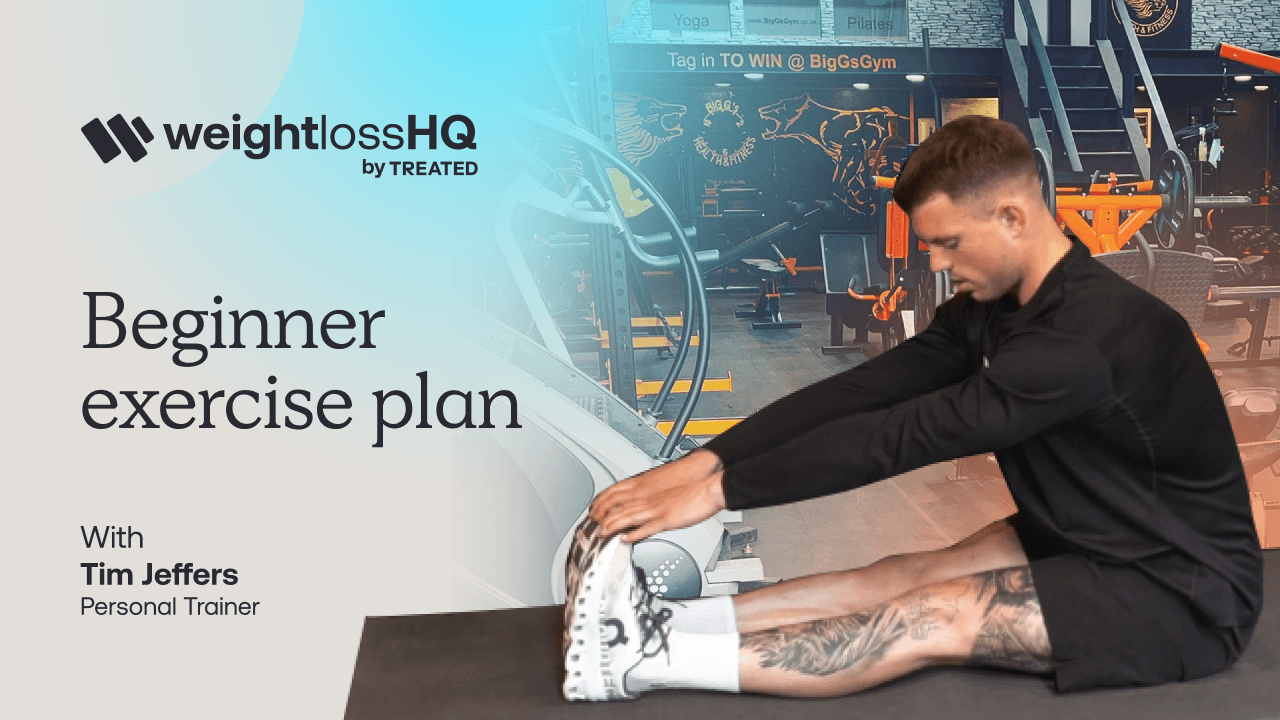
Sit on the floor with your legs extended away from you, and reach out towards your toes. Hold for 10-20 seconds.
Then, move on to the cat-cow stretch.
Kneel down on your hands and knees, with your hands shoulder width apart and your knees hip width apart.
As you inhale, arch your lower back, tilt your pelvis up, and lift your head. Exhale and lift your abdomen and arch your spine, lowering your head and pelvis. Alternate between these two poses as you breathe.
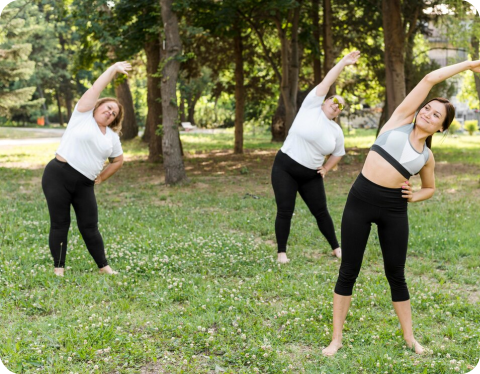
Next up is side stretches. Stand upright with your feet shoulder width apart, Raise one arm above your head and keep the other flat by your side. Lean to one side, so the raised arm goes over your head, and you lower the shoulder of the arm by your side. Return to your starting position, and swap sides.
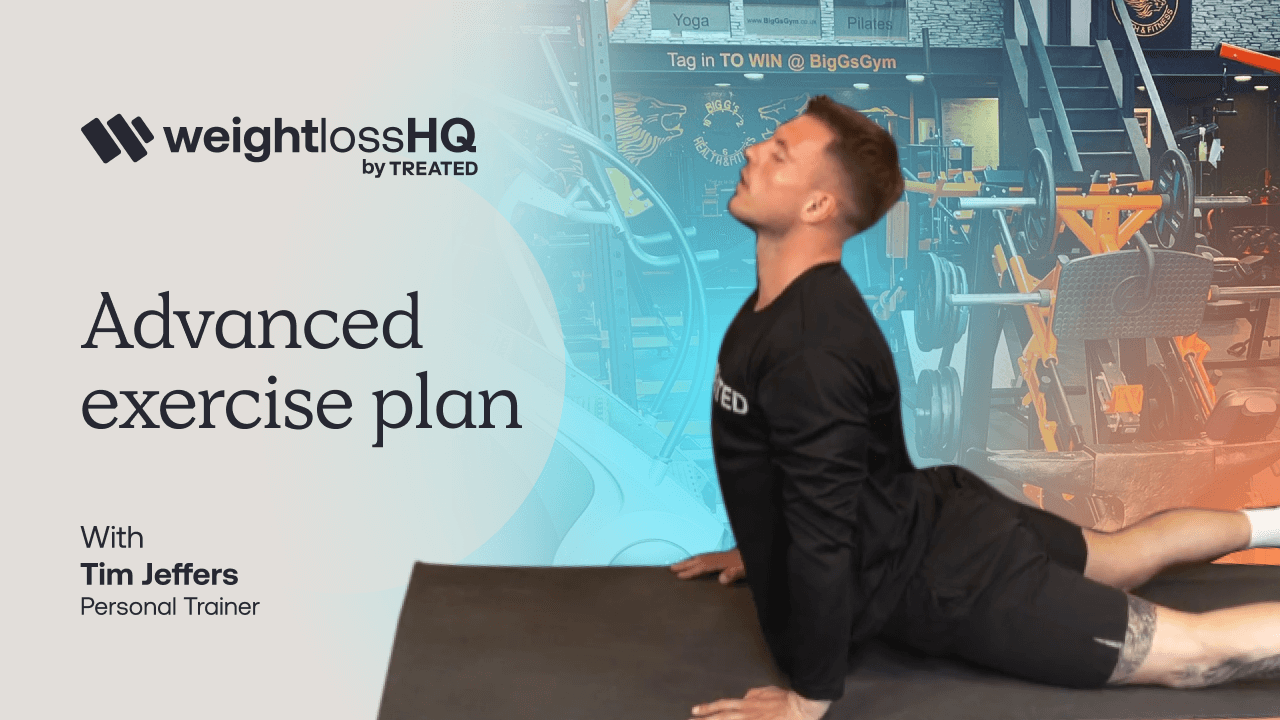
You’ll finish with the child’s pose. Kneel down, and sit back on your heels with your toes touching. Reach your arms forward, and rest your head on the mat. Slowly inhale and exhale for at least eight breaths.
Improving your mental strength
For a lot of people, the difficult part of undertaking a new exercise programme is getting started. Once you’re active, though, you’ll start to see positive physical and mental changes.
Aerobic exercise has been proven to help reduce anxiety and depression,[3] so when you’re working out regularly, your mental resilience can improve along with your strength and stamina.
Weight loss is different for every person. This means some people might lose weight faster than others. It’s also normal to experience plateaus on your journey. This is when your weight stays at a certain level, and doesn’t seem to be coming down past a certain point.[4]
This might be frustrating, but you should remember that losing weight doesn’t always happen in a linear way. You might experience drops some weeks or months, and none during others.
The exercise routines and changes to your diet are intended to be part of your lifestyle, so you shouldn’t abandon them when you feel like your weight loss is stalling. They will help you maintain your weight until you find a way to break through the plateau — it could be that you need to create a bigger calorie deficit, or that you need to add more intense workouts to your exercise programme to burn more calories.
Keeping focused on your progress
There are lots of ways to monitor the progress you’re making on your weight loss journey. Keeping a diary or making use of exercise apps are positive ways of looking at the changes you’re making.[2] The most obvious one is weighing yourself regularly, but it’s important to not focus all your efforts on the number on the scale.
You’re using the pens to help you lose weight, but by combining a fresh approach to eating healthily with regular, challenging exercise, you’re making changes you can stick with long-term.
- Ndetei, D.M., Pascalyne Nyamai and Mutiso, V. (2023). Boredom–understanding the emotion and its impact on our lives: an African perspective. Boredom–understanding the emotion and its impact on our lives: an African perspective, 8.
- Burke, L.E., Wang, J. and Sevick, M.A. (2011). Self-Monitoring in Weight Loss: A Systematic Review of the Literature. Journal of the American Dietetic Association, [online] 111(1), pp.92–102.
- Sharma, A., Madaan, V. and Petty, F.D. (2006). Exercise for Mental Health. Primary Care Companion to The Journal of Clinical Psychiatry, [online] 8(2), p.106.
- Sarwan, G. and Rehman, A. (2024). Management of Weight Loss Plateau. [online] PubMed.
When we present you with stats, data, opinion or a consensus, we’ll tell you where this came from. And we’ll only present data as clinically reliable if it’s come from a reputable source, such as a state or government-funded health body, a peer-reviewed medical journal, or a recognised analytics or data body. Read more in our editorial policy.
Share your thoughts.
Was this info helpful?