
Staying motivated and overcoming challenges when exercising to lose weight
Struggling to stay motivated? Your guide to overcoming common exercise obstacles.
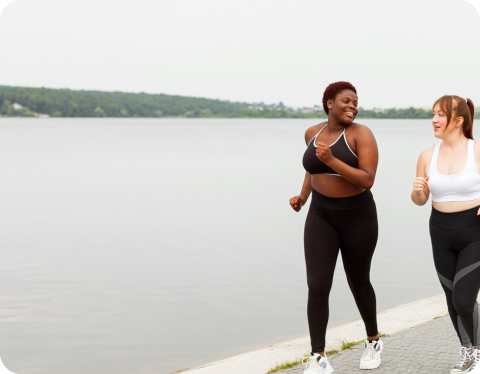

Exercise can play a crucial role in your weight loss journey. But finding and maintaining motivation to exercise can also be challenging. Fortunately, there are a few practical ways you can stay motivated to keep exercise as part of your routine during your weight loss journey. From SMART goal setting to pursuing activities you enjoy, we’ve got practical tips to help you on your way.
Overcoming exercise challenges
When starting from scratch with exercise it’s normal to face obstacles. If you’ve also recently started a weight loss treatment, this too can come with its own set of challenges when wanting to exercise. It can feel overwhelming especially if you have no clear plan and lack motivation. But there are steps you can take to drive your commitment and overcome these challenges.
Tackling fatigue
Incorporating exercise into your routine can leave you feeling fatigued. Especially if you’re on a calorie-deficit diet or using weight loss treatments. While in the long run exercising should give you more energy, initially, you might feel more tired.
Having a small pre-workout snack (like Greek yoghurt with fruit or a handful of nuts) about 30-60 minutes before exercising can give you a helpful energy boost. Additionally, nourishing yourself with a well-balanced meal after a workout may also help. Try preparing your meal before exercising so that it’s ready and waiting for you when you need it, this could help prevent impulsive snacking or opting for a takeaway.
Aiming for shorter workouts rather than longer ones can also make exercising more manageable when you’re tired – it’s better to do a 20-minute workout than nothing at all. You can also prevent overexhaustion by listening to your bodily cues when it becomes tired. If you feel you can’t do a high intensity workout, opt for yoga or a walk instead.
It’s also important to take a break from working out throughout your week. Avoid overdoing your workouts. Take mini breaks between each rep, lap, or session. And try planning your workouts for when your energy levels are at their highest. This will differ for each person, so find a time that works for you.
Fatigue caused by weight loss treatment
When using weight loss treatments, it’s often recommended to go on a calorie-deficit diet, but eating fewer calories might initially lead to lower energy levels. To avoid this, try not to drastically reduce your calorie intake, like going from 3000 Kcal a day to 1500 Kcal overnight. Instead, gradually reduce your calorie intake to allow your body to adjust.
Remember, certain treatments, like Wegovy, work by suppressing your appetite, potentially making it harder to get the recommended levels of vitamins and nutrients through your diet alone. This is where supplements could help. By taking a multivitamin, you can ensure adequate intake of essential nutrients.2 But make sure to check with your doctor before taking any supplements.
Nausea
Nausea is a common side effect of weight loss injections. It can make you feel less inclined to exercise and might even make you feel like stopping your treatment altogether.
But you can do things to help improve this side effect. First up, take a look at your eating habits. Focus on smaller, more frequent meals, rather than big meals which can overwhelm your digestive system. Avoid spicy, oily, and heavily processed foods, and instead, choose simple, nutritious options. Also, refrain from consuming large meals right before or after exercising.3
Ginger and mint can be used to help ease nausea symptoms. Supplements or tea might help to calm your symptoms. If needed, some honey can be added for the sweetness.4
Initial discomfort
Exercising might be especially uncomfortable if you haven’t done it in a while. It’s always good to start slow, like by exercising around three days a week with rest days in between. This will make sure your body has enough time for rest and recovery. Once you feel you’re able to do more, you can increase the frequency or the intensity of the exercise. You should also include a quick warm-up so your body is prepared for the exercise.
After exercising, it’s common for your muscles to feel sore and tender, typically occurring 24 to 48 hours later. This soreness is caused by micro-tears in the muscle, which are a natural part of the muscle adaptation process. It might sound scary, but this process actually strengthens your muscles, making them more resilient. While it’s normal to experience some discomfort, it’s important to differentiate between ‘good pain’ and ‘harmful pain’.
A normal level of discomfort will feel tender or tight and usually only lasts 1-2 days. Whereas, potentially harmful pain will be:
- sharp,
- localised to one area – for example, after completing a shoulder workout you only feel it on the right side of your shoulder, not the left,
- in your joints, or
- long-lasting.
In these cases, you should consult a fitness professional or doctor to ensure it’s not a serious injury. Refrain from further exercise to prevent the issue from worsening.
How to set goals
When exercising to lose weight, setting goals is crucial. Having realistic goals should help you stay motivated as you meet them. It’s also a great way to track your progress.
A good place to start is with the SMART goal concept, which should help you set achievable goals and prevent you from creating unrealistic ones. SMART is an acronym for:
Specific – a goal that’s clearly defined and focused on what you want to achieve.
Measurable – trackable so you can monitor your progress.
Attainable – realistic and achievable within your means.
Relevant – aligns with your wider plan, values and ambitions.
Time-bound – given a specific timeframe for completion.
An example of a SMART plan would be –
- Specific – I will exercise on Mondays, Wednesdays and Saturday mornings as this works with my schedule. I will commit 45 minutes on weekdays and 1hr on weekends. It will be at the gym by the office after work.
- Measurable – To assess my progress I’ll wear a fitness watch and log my progress on my phone.
- Attainable – I only have the time to go to the gym three times a week, so I won’t push myself to do more as I know that would be unrealistic.
- Relevant – Exercising aligns with my long-term goals of losing weight.
- Time-bound – My current plan is to go to the gym three times a week for a year. If I don’t reach my goal or exceed my expectations at the gym, I’ll make the appropriate changes in my plan.
How to make exercise fun
Staying motivated when exercising can be hard if it starts to feel like a chore. It can also be challenging to keep motivated – especially if you aren’t seeing the results as fast as you’d hoped. However, there are ways to make exercise more enjoyable. Here are some tips to help you stay motivated and have fun while exercising:
Try new activities
Although it’s good to stick to your workout plan, incorporating new or different activities every now and then can add variety, making it more enjoyable. Try activities such as zumba, pilates, wall-climbing or join a new workout group. You can also learn a new skill, like rollerblading or skateboarding. By trying out new activities and switching things up, you can keep your motivation levels high and make exercise more enjoyable.
Socialise your workouts
Making your workout a social event can make it more fun. Going on workout dates with your friends or partner can take away the daunting feeling of having to go alone.
While it might not always be possible to have a workout buddy every session, you can plan weekly or monthly dates to keep each other accountable. Additionally, trying out different activities like hiking or pilates can make things more interesting and less monotonous. This is also a good opportunity if you want to try something new as you’ll have someone to do it with.
Influencer motivation
If you’re struggling to buddy up with a friend then turning to your socials could be an option, following influencers who share similar goals can be motivating. Seeing other individuals pursuing the same activities or objectives as you can be incredibly inspiring. Some research has shown that following trustworthy, and knowledgeable influencers can significantly boost your motivation and engagement in physical activity.5 Furthermore, joining online groups or forums can create a sense of community, which can feel encouraging.
Incorporating activity into your routine
Even when you’re not exercising, adding activity to your normal routine is a great way to stay active and keep on top of your goals.
Doing seemingly small things like parking five minutes away from work so you can add to your step count, can be viewed as a mini ‘win’ and contribute to your weight loss goals. Other activities could include:
- Taking the stairs instead of the escalators.
- Walking or biking to work.
- Using a standing desk at work or home to reduce sedentary behaviour.
- Spending time gardening to engage various muscle groups and improve flexibility.
- Turning household chores into workouts by adding intensity. For example, doing lunges while vacuuming or squats while brushing your teeth.
- When bingeing a TV series, work out for 5-10 mins before each episode. This can be as simple as running on the spot.
Reward yourself
Rewarding yourself for reaching exercise milestones isn’t just about celebrating achievements; it’s about fuelling your motivation for the journey ahead. When creating your weight loss plan, add in targets and milestones. Once you’ve reached them, reward yourself.
These rewards don’t always have to revolve around food or indulgent ‘cheat’ days. While an occasional treat can be a healthy way to avoid feeling deprived, having them too often can cause you to lose some of your progress. So spend some time thinking of something that will truly feel like a reward like a new book, a massage or a trip out somewhere.
You can also plan your rewards to match your progress. For instance, when you achieve significant milestones, like losing half of your target weight, treat yourself to a special experience, such as a weekend getaway.
By associating exercise with positive experiences you’re reinforcing your commitment to your health and fitness journey, ensuring that motivation remains high even when faced with challenges.
- Teixeira, P. J., Carraça, E. V., Markland, D., Silva, M. N., & Ryan, R. M. (2012). Exercise, physical activity, and self-determination theory: A systematic review. The International Journal of Behavioral Nutrition and Physical Activity, 9, 78.
- Dodd, F.L., Kennedy, D.O., Stevenson, E.J. et al. Acute and chronic effects of multivitamin/mineral supplementation on objective and subjective energy measures. Nutr Metab (Lond) 17, 16 (2020).
- Bischoff, S.C. and Renzer, C. (2006). Nausea and nutrition. Autonomic Neuroscience, 129(1-2), pp.22–27.
- Lete, I., & Allué, J. (2016). The Effectiveness of Ginger in the Prevention of Nausea and Vomiting during Pregnancy and Chemotherapy. Integrative Medicine Insights, 11, 11-17.
- Durau, J., Diehl, S., & Terlutter, R. (2022). Motivate me to exercise with you: The effects of social media fitness influencers on users’ intentions to engage in physical activity and the role of user gender. Digital Health, 8.
When we present you with stats, data, opinion or a consensus, we’ll tell you where this came from. And we’ll only present data as clinically reliable if it’s come from a reputable source, such as a state or government-funded health body, a peer-reviewed medical journal, or a recognised analytics or data body. Read more in our editorial policy.

Share your thoughts.
Was this info helpful?