
Weight Loss Injection Survey: The Results
You spoke, we listened. Data from real weight loss injection users, analysed.
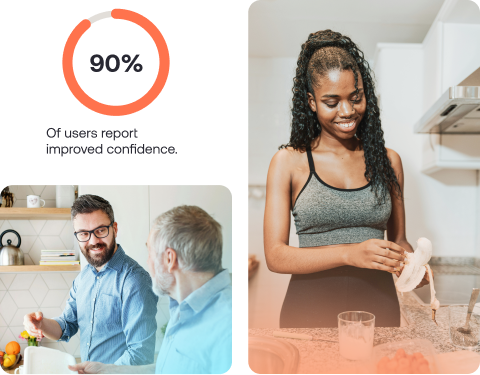

You talked, we listened. We got real-world stories and statistics from 282 of you, all about your experiences of losing weight with weight loss injection (WLI) treatments.
Here’s what you said.
Why did we do the survey?
Weight loss injections are a new and increasingly common form of treatment. (And for good reason: they’re really quite effective.) But, as overweight and obesity are complex conditions that overlap on the societal level, it’s not just the raw, numerical data of these treatments that we’re interested in. We wanted to gain a deeper sense of:
- the impact that these treatments had on you;
- what crossover they had with your eating and exercise habits; and:
- how we as providers can use this info to improve your care.
Because we believe that good health is a conversation. A two-way street. It helps us inform our decision making when it comes to the content we produce and the support we provide. It helps us understand the real-world impact of the treatments we send out and means that we, in turn, can pass on that information to others. So they can better learn what their treatment journey might entail before they embark on it. Put simply, your treatment stories are important to us because they’re important to you.
Now for some stats.
Results after three months:
Of those we surveyed (282 respondents), 103 had been using weight loss injections for more than three months.
As we all intuitively know, weight loss doesn’t just happen overnight. So while we surveyed all of our weight loss injection users, we’ll focus on those who’ve had the chance to see long-term results first.
Weight loss injections tend to be a long-term treatment, with the recommendation being that most people use them for at least a year before stopping. So, ideally, we’d highlight their stories to give you a sense of how your experience might be. But these treatments are still pretty new, so most of our users haven’t been using them for that long (only 14% of those we surveyed had been using treatment for more than six months). And weight loss is a journey, so how we feel at the milestones along the way can be just as important as how we feel at the destination.
81% of users lost significant weight
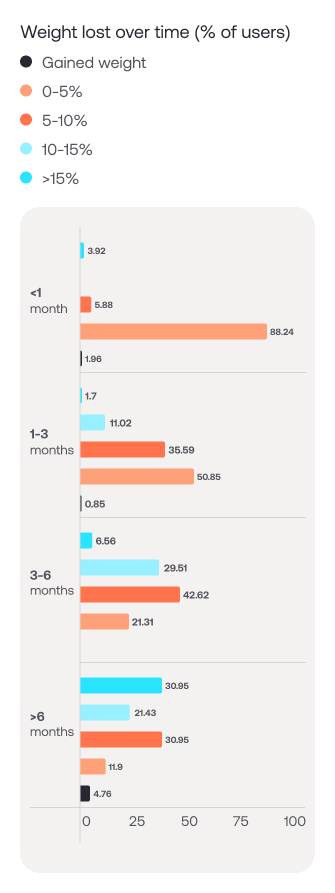
We asked the question: ‘What % of your starting weight have you lost since taking weight loss injections?’, and of those who had been using weight loss injections for more than three months, 80.6% had lost more than 5% of their body weight (an amount generally accepted as “clinically meaningful”). [1]
Broken down even further:
- 37.9% of users lost 5-10%
- 26.2% lost 10-15%
- 16.5% lost more than 15%
This seems like impressive levels of weight loss. But what does this mean, and how does it compare to wider statistics?
First, let’s look at the health impacts of losing more than 5% body weight when you have an overweight or obese BMI:
- An average weight loss of 6.7% can reduce diabetes risk by 58%. [2]
- 5% weight loss reduces intrahepatic triglyceride (excess fat buildup in the liver) by 13%. [2]
- 5-10% weight loss is associated with a 22% reduction in the likelihood of developing metabolic syndrome (an umbrella term for several precursors to stroke, diabetes and heart disease). [3]
So it’s clear to see that even a ‘modest’ 5% weight loss can bring about clear, tangible benefits to health. Weight loss injections being able to facilitate this level of change after just three months, then, reinforces the level of impact they can have in just a short space of time.
And how do our findings compare with those of the broader scientific community? Pretty similarly, actually. In one study, semaglutide (the active ingredient in Wegovy) patients lost an average of 6% body weight by week 12 and 12% by week 28. [4]
82% of users felt more healthy
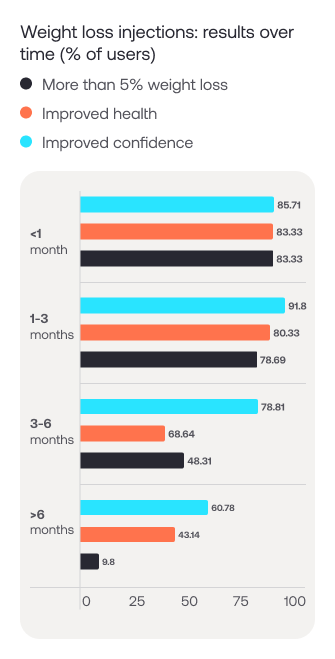
From the question: ‘Has your health improved since starting weight loss injections?,’ 81.5% (84 of 103) users responded either ‘Yes, a lot,’ (22) ‘Yes, somewhat,’ (39) or ‘Yes, a little.’ (23). Only 1 user said their health had worsened. This is compared to 81 of 118 users (68.6%) who had been using them for less than three months, or the 67.8% of overall users we surveyed (including those who stopped).
This strongly suggests that weight loss injection users feel more healthy over time, as they become more accustomed to the medication and its effects.
It was important to us to find out this information alongside the simple weight loss data, as we believe that your weight loss journey should be just as much about the non-scale victories as the numerical ones. Feeling healthier is a more holistically encompassing and forgiving metric with which to measure your journey, and it’s important to remember that health and weight don’t always correlate.
It was also important for us to understand if a significant amount of weight loss injection users had lost weight, yet felt less healthy. This is because it could suggest to us that users were struggling with health issues unrelated to weight that weren’t affecting them beforehand, such as side effects. Based on these findings, though, side effects don’t seem to be significant enough to counteract the positive health effects of the drug over time.
9 in 10 users felt more confident
Of the 103 users who had been taking WLIs for more than three months, a hugely significant 92 responded ‘Yes’ to the question: ‘Has your confidence improved since starting weight loss injections?’. Of the remaining 11 respondents, none responded that their confidence had worsened. Even when taking into account the overall figures, only 2 of 282 overall respondents told us their confidence had decreased since starting their treatment.
This was another important question for us to ask, because it touches on both the societal and mental health impacts of overweight and obesity. Along with living longer, healthier lives, the impact of feeling happy and confident within oneself can’t be overlooked when it comes to the motivations of weight loss.
The fact that 89.3% of users reported improved confidence after three months (versus 78.7% overall) further reinforces the impact that these medications are having beyond the superficial. These findings show that—even for those that haven’t lost a clinically significant amount of body weight—WLIs can help boost health and confidence. (And to us, this data is more important than the number on the scale. This is more representative of how you’re feeling in your day-to-day life.)
71.9% of users saved money on food
When we asked the question: ‘Have you saved money on food shopping/takeaway food/eating out since starting treatment?,’ 66.7% (two-thirds) of our overall respondents reported that they’d saved at least a little. But when you break it down to those in the three-month-or-more bracket, the number jumps a little to 71.9%. And of those who didn’t save, only 2.5% say they’ve spent more since starting treatment.
If you’re interested in this, elsewhere you’ll find we’ve gone into the financial considerations of weight loss in more depth. But to summarise, there’s not a great deal of conclusive evidence on whether it is or isn’t cheaper to eat healthy. A lot of ultra-processed foods can be mass-produced at minimal expense, making them cheaper to buy at the supermarket. (And we know that eating more ultra-processed foods tends to lead to worse health outcomes to a diet rich in whole foods.) [5],[6] However, the effect of eating less, and having fewer cravings, led us to wonder whether the cost of buying fewer food items both at the shop and from restaurants or takeaways would be enough to counteract this at the practical level.
And it seems—for most people anyway—that it is.
This might be reassuring for many people to know because, unfortunately, weight loss injections are still quite expensive at the moment. This means that, for many users, it can be a bit of a balancing act to weigh up whether or not they’re worth it. Knowing that using these medications may cost more in the short-term but lead to long-term savings on the grocery list might help people to understand that the cost might be worth it over a long enough timeline.
Results after six months:
Below you’ll find a further analysis of those who have been using WLIs for longer than six months (42 of 282 respondents). As this is a smaller sample size, it’s worth being a little more tentative about the significance of the findings.
More than half lost over 10% body weight
Of the 42 respondents, 52.6% said they’d lost more than 10% of their starting weight. Similar to our findings from those using treatment for three months or more, this data largely resembles the findings from clinical trials, in which an average of 12% weight loss was seen after 28 weeks with semaglutide.
Let’s have a look at some of the positive health effects of losing this amount of weight when your starting weight was in the ‘overweight’ or ‘obese’ BMI category:
- In a study looking at liver scarring in people with non-alcoholic fatty liver disease (NAFLD), 10% weight loss was the only factor to decrease scarring. [7]
- 10% or more weight loss is the goal for impacting the clinical symptoms of obstructive sleep apnoea. [2]
- In a study looking at the effects of overweight and obesity on osteoarthritis of the knee, average weight loss of 10.6% produced significant improvement in pain, function, and quality of life. [2]
Broadly speaking, the positive effects of weight loss incrementally improve with each percentage of body weight lost (until a healthy BMI is reached). [2]
Users continued to feel healthier
Despite the numbers, it can be argued that losing weight in a healthy, sustainable way that leaves you feeling good is the most important thing. And the good news is that, at the six-month-or-more mark, 83.3% of respondents reported feeling more healthy than they did before they started treatment (a modest improvement on 80.3% of users at 3-6 months).
This suggests that users continue to feel more healthy over time on weight loss injections, with the positive effects showing a long-durational, incremental effect.
This is important, not just from an empathetic perspective (we’re happy that our treatments help people to feel better), but from a medicinal one too. Quality of life is one of the most important metrics in medicine, because really, it’s what it’s all about.
The fact that users are ‘feeling’ healthier on weight loss injections gives us a little glimpse into both their physical and mental wellbeing. And several studies have shown the powerful impact that outlook and stress improvements have on physical health. So it’s all connected, which is why we’re so keen on stressing the importance of a holistic approach when it comes to weight loss.
The beginnings of a plateau?
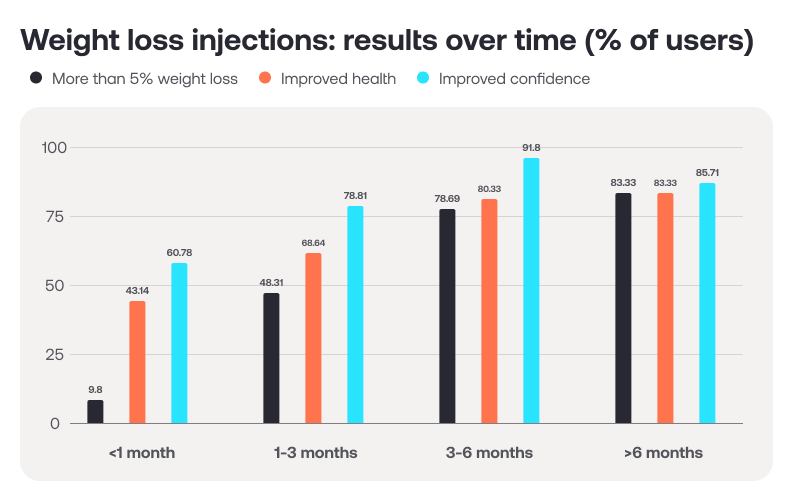
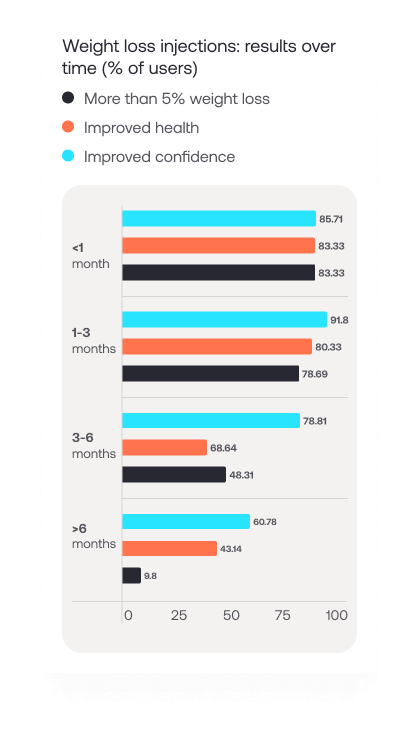 Interestingly, when you look at the difference between metrics from 3-6 months to 6+ months, progress seems to start to level off (and confidence levels even seem to decrease).
Even though weight loss levels are still increasing, the rate seems to be lower than it was previously. This could be as simple as the 6+ month respondents not having used treatment for much longer than those in the 3-6 month bracket. But it might also be that this is quite a common time for people to experience a plateau.
According to a report published in Nature in April 2024, a typical weight loss trajectory involves rapid weight loss followed by a plateau after around six months. The report concluded that weight loss plateaus are a normal, physiological part of losing weight, as your body adapts to lower levels of calories.[15] This can cause frustration and, naturally for many, a dip in confidence (which we can see in the graph above).
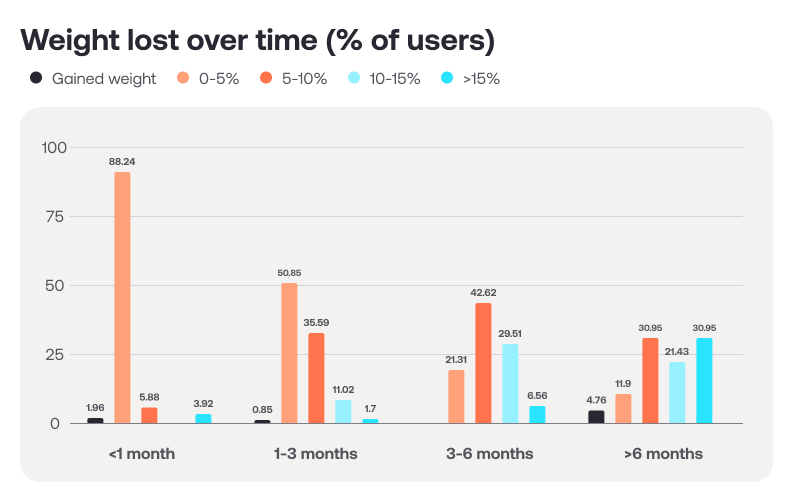
Interestingly, though, the 6+ month cohort is the only bracket where a notable number of respondents had both lost more than 15% of their body weight and gained weight. This potentially points to the 6+ month mark as a point of divergence, where you might either overcome your plateau and continue to lose more weight, or become despondent and start to gain weight.
What results do weight loss injection users see after just a month?
When looking at the results of those who have been using a WLI between 1-3 months, nearly half (48.3%) have lost more than 5% body weight, over two-thirds say their health has improved (68.6%), over three-quarters (78.81%) report improved confidence and 70% say they’ve saved money on food. So clear results can be seen from even a short amount of time on the treatment, as the medication starts to work and lifestyle changes help people to feel more healthy and confident.
It seems to be the start of a trend that continues over time, where health, weight loss and confidence improve at a consistent rate up to six months of use, as you can see (again) in the graph below.
Additional stats and interesting insights
Back pain – do weight loss injections help?
Of those who reported that they had back pain before starting treatment (95 of 282 users), 48.4% (nearly half) said that their back pain had improved. So it can be suggested that weight loss injections can have a beneficial effect on back pain. This assumption is reinforced when we only look at those who had back pain before starting treatment and have been using WLIs for three months or more, where an even greater portion reported improvement (52.8%).
Although this is only a sample of a small number of users, the data does seem to suggest that weight loss injections can bring about an incremental improvement in back pain over time.
Interestingly, 29% of weight loss injection users said that performing specific back workouts helped to reduce their existing back pain. This suggests that a combination of weight loss and targeted exercises could be the most effective way to help tackle weight-related joint and muscle issues.
Is it helpful to join a gym? The pros and cons
We asked the question: ‘Have you joined a gym since starting weight loss treatment?’, and 37.7% of respondents said they had.
Judging by the responses of those that joined a gym, it seemed to have an additional benefit to health: 75% of ‘gym-joiners’ said their health had improved since starting treatment, versus 64% of those that hadn’t joined a gym.
If we’re just looking at the raw numbers, however, it seems as though joining a gym is less beneficial for weight loss (47.3% of those who joined a gym lost more than 5% body weight, versus 56.9% of those who didn’t).
Perhaps this is because the additional muscle mass caused by exercising or lifting weights counteracts weight lost from fat reduction. It could also be that working out might lead to eating more, which is a theory proposed when the same effect has been seen before.[8] It’s worth noting, too, that ‘joining a gym,’ doesn’t necessarily equate to ‘going to a gym’. (Or exercising more, for that matter — plus, some people lift weights at home.)
Whatever the reason, it’s important to notice the difference between these two results, as it may further highlight the importance of ‘non-scale victories’. If taking steps like joining a gym can lead to increased feelings of health, then the amount of weight lost becomes a bit less important.
We also asked those who hadn’t joined a gym which barriers had stopped them. Here’s a breakdown of how they answered:
- No, because I prefer working out at home – 17.8%
- No, because I’ve found other good ways to exercise without one – 16%
- No, because memberships are too expensive – 3.6%
- No, because I don’t have the time to go – 5.7%
- No, because gym environments make me feel anxious – 2.5%
- No, but for a different reason – 16.7%
So of those who haven’t joined a gym since starting treatment, most didn’t because they prefer working out at home or exercising elsewhere. We also asked those who selected one of the ‘No’ options to elaborate. Some common reasons included: already being a member of a gym; not living near a gym; preferring to run or walk instead; injury or ill health; and simply not having the time.
So we recognise that gyms aren’t the best or most viable option for everyone. As a result, we’ve put together some easy, at-home workouts for you to try.
Most effective strategies for weight loss, ranked
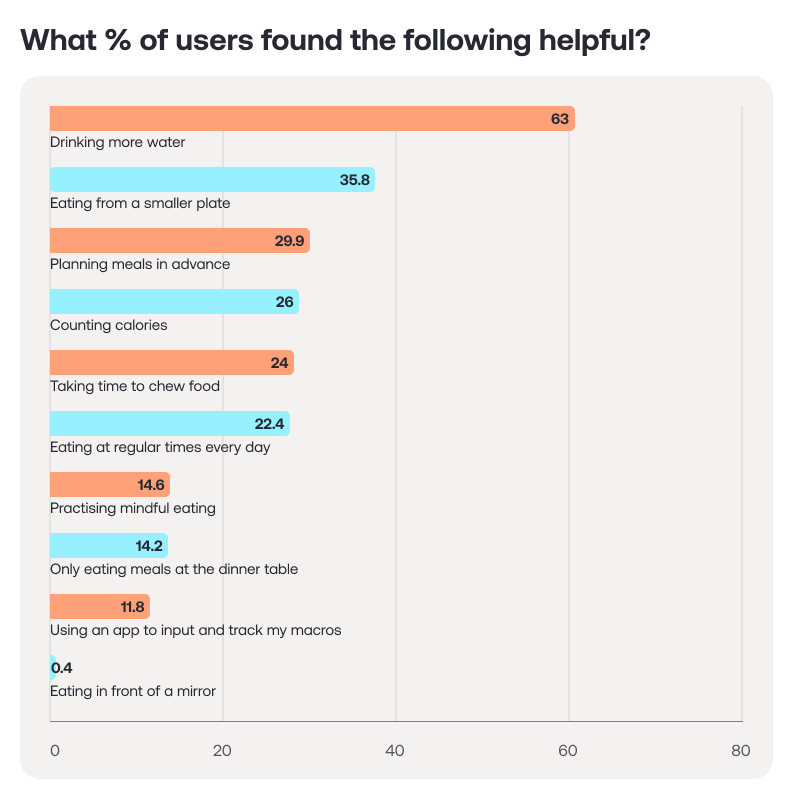
We asked the question ‘Have you found any of the following helpful?’ and allowed participants to select as many answers as they liked.
According to the results, ‘Drinking more water’ was the most helpful option, by quite some margin (a little more on that in a moment). By contrast, only one user found ‘eating in front of a mirror’ to be helpful.
Second most popular on the list was ‘eating from a smaller plate’. Some research shows that reducing plate size can have a measurable impact on reducing portion size, but it also reduces people’s serving size of vegetables, too. As a result, the study suggested that more research would need to be carried out, and cautioned against recommending it due to reduced healthy food consumption. [9]
‘Planning meals in advance’ was next, which might be a useful strategy because it helps avoid the temptation to opt for a quick and easy option like a takeaway or ready meal. Research helps back this up too, with a study on French adults showing that those who meal-planned adhered better to nutritional guidelines, ate a greater variety of foods, and were less likely to have an obese or overweight BMI. [10]
Theoretically, you might expect ‘counting calories’ to be higher up the list (although it is still quite high). That’s because, if you were to take a simplistic view, the primary component of weight loss is a calorie deficit (weight loss can’t happen without it). In practice, though, calorie counting isn’t for everyone. It can lead to unhealthy fixations with food and numbers, and your metabolic rate can fluctuate, meaning it can be tough to know exactly how many calories you’re using in a day. According to recent research, a better approach is to understand the influence of food on hunger, cravings and energy levels. [11]
The importance of water
Due to the open-ended nature of the question ‘Have you found any of the following helpful?’, we weren’t entirely sure whether the participants found drinking more water to be helpful for side effects, weight loss, or both. But there’s no denying that it seems to be helpful overall, with a highly significant 63% of respondents answering that it was.
Common side effects of weight loss injections include nausea, vomiting, constipation, diarrhoea and headache. And water can help with all of these. It’s recommended by our prescribing clinicians to help you manage your side effects and is advised by the manufacturers of Wegovy. [12]
And research shows that increasing your hydration levels can help with weight loss, too. It’s not entirely clear why this is, but it’s thought that increased metabolism may play a role because it helps your mitochondria (organelles that provide most of your cells’ energy) to function better. [13] Another study found that it might help with appetite suppression. [14]
Survey information
This survey was carried out between 30/04/2024 and 15/05/2024. Participants were invited to take the survey via email, all of which have purchased weight loss injection medication from us before.
A total of 282 respondents completed the survey, from the UK, Netherlands and Denmark.
Declaration of interest: Treated provides a medical consultation and online pharmacy service, prescribing and dispensing weight loss injections, among other treatments.
- Williamson, D.A., Bray, G.A. and Ryan, D.H. (2015). Is 5% weight loss a satisfactory criterion to define clinically significant weight loss? Obesity, 23(12), pp.2319–2320.
- Ryan, D.H. and Yockey, S.R. (2017). Weight Loss and Improvement in Comorbidity: Differences at 5%, 10%, 15%, and Over. Current Obesity Reports, [online] 6(2), pp.187–194.
- Knell, G., Li, Q., Pettee Gabriel, K. and Shuval, K. (2018). Long-Term Weight Loss and Metabolic Health in Adults Concerned With Maintaining or Losing Weight: Findings From NHANES. Mayo Clinic Proceedings, 93(11), pp.1611–1616.
- Ghusn, W., De la Rosa, A., Sacoto, D., Cifuentes, L., Campos, A., Feris, F., Hurtado, M.D. and Acosta, A. (2022). Weight Loss Outcomes Associated With Semaglutide Treatment for Patients With Overweight or Obesity. JAMA Network Open, [online] 5(9), p.e2231982.
- Lane, M.M., Gamage, E., Du, S., Ashtree, D.N., McGuinness, A.J., Gauci, S., Baker, P., Lawrence, M., Rebholz, C.M., Srour, B., Touvier, M., Jacka, F.N., O’Neil, A., Segasby, T. and Marx, W. (2024). Ultra-processed food exposure and adverse health outcomes: umbrella review of epidemiological meta-analyses. BMJ, [online] 384(384), p.e077310.
- Elizabeth, L., Machado, P., Zinöcker, M., Baker, P. and Lawrence, M. (2020). Ultra-Processed Foods and Health Outcomes: A Narrative Review. Nutrients, [online] 12(7), p.1955.
- Glass, L.M., Dickson, R.C., Anderson, J.C., Suriawinata, A.A., Putra, J., Berk, B.S. and Toor, A. (2014). Total Body Weight Loss of ≥10 % Is Associated with Improved Hepatic Fibrosis in Patients with Nonalcoholic Steatohepatitis. Digestive Diseases and Sciences, 60(4), pp.1024–1030.
- Cox, C.E. (2017). Role of Physical Activity for Weight Loss and Weight Maintenance. Diabetes Spectrum, [online] 30(3), pp.157–160.
- Hughes, J.W., Goldstein, C.M., Logan, C., Mulvany, J.L., Hawkins, M.A.W., Sato, A.F. and Gunstad, J. (2017). Controlled testing of novel portion control plate produces smaller self-selected portion sizes compared to regular dinner plate. BMC Obesity, 4(1).
- Ducrot, P., Méjean, C., Aroumougame, V., Ibanez, G., Allès, B., Kesse-Guyot, E., Hercberg, S. and Péneau, S. (2017). Meal planning is associated with food variety, diet quality and body weight status in a large sample of French adults. International Journal of Behavioral Nutrition and Physical Activity, 14(1).
- Benton, D. and Young, H.A. (2017). Reducing Calorie Intake May Not Help You Lose Body Weight. Perspectives on psychological science : a journal of the Association for Psychological Science, [online] 12(5), pp.703–714.
- Novo Nordisk (n.d.). Wegovy® Side Effects | Wegovy® (semaglutide) Injection 2.4 mg. [online] www.wegovy.com.
- Thornton, S.N. (2016). Increased Hydration Can Be Associated with Weight Loss. Frontiers in Nutrition, [online] 3(18).
- Vij, V.A.K. and Joshi, A.S. (2014). Effect of excessive water intake on body weight, body mass index, body fat, and appetite of overweight female participants. Journal of Natural Science, Biology, and Medicine, [online] 5(2), pp.340–344.
- Landry, M.J., Ward, C.P., Cunanan, K.M., Fielding-Singh, P., Crimarco, A. and Gardner, C.D. (2024). Switching diets after 6-months does not result in renewed weight loss: a secondary analysis of a 12-month crossover randomized trial. Scientific Reports, [online] 14(1), p.9865.
When we present you with stats, data, opinion or a consensus, we’ll tell you where this came from. And we’ll only present data as clinically reliable if it’s come from a reputable source, such as a state or government-funded health body, a peer-reviewed medical journal, or a recognised analytics or data body. Read more in our editorial policy.



Share your thoughts.
Was this info helpful?